`编程语言`分类下的文章

编程语言

Go语言包-path/filepath

一天一个Golang包,慢慢学习之“path/filepath”

上一篇学习了path包,了解了几个对路径处理的方法。今天继续完成它的子包“filepath”,包中的函数会根据不同平台做不同的处理,如路径分隔符、卷名等。

阅读文档:

官方pkg地址:https://golang.org/pkg/path/filepath

包方法

func Base(path string) string
func Clean(path string) string
func Dir(path string) string
func Ext(path string) string
func IsAbs(path string) bool
func Join(elem ...string) string
func Match(pattern, name string) (matched bool, err error)
func Split(path string) (dir, file string)
// 以上8种方法跟path包同名方法功能类似


func Abs(path string) (string, error)
// 返回相对当前路径的path的绝对路径

1
2
3
4
5
6
7
8
9
10
11
12
fmt.Println(filepath.Abs(""))
fmt.Println(filepath.Abs("name.txt"))
fmt.Println(filepath.Abs("/name.txt"))
fmt.Println(filepath.Abs("../name.txt"))
fmt.Println(filepath.Abs("~/../name.txt"))
/*
/Users/anthony/Workspaces/GoLand/src/application/learn/path/filepath <nil>
/Users/anthony/Workspaces/GoLand/src/application/learn/path/filepath/name.txt <nil>
/name.txt <nil>
/Users/anthony/Workspaces/GoLand/src/application/learn/path/name.txt <nil>
/Users/anthony/Workspaces/GoLand/src/application/learn/path/filepath/name.txt <nil>
*/

func EvalSymlinks(path string) (string, error)
// 返回Path的实际路径(如果path是个软链接的话)

1
2
fmt.Println(filepath.EvalSymlinks("/etc"))		// /private/etc <nil>
fmt.Println(filepath.EvalSymlinks("/usr/local"))// /usr/local <nil>

func ToSlash(path string) string
func FromSlash(path string) string
// 以上两种方法作主要用于Windows平台。
// 将path中的平台相关的路径分隔符(或’/‘)转换为’/‘(或平台相关的路径分隔符)


func Glob(pattern string) (matches []string, err error)
// 列出与指定模式pattern完全匹配的文件或目录,匹配原则同Match一样。

1
2
fmt.Println(filepath.Glob("/usr/*"))
// [/usr/bin /usr/include /usr/lib /usr/libexec /usr/local /usr/sbin /usr/share /usr/standalone] <nil>

func HasPrefix(p, prefix string) bool
// 该方法已弃用,不再被建议使用。


func Rel(basepath, targpath string) (string, error)
// 返回targpath相对于basepath的路径。
// 要求二者必须同为“相对路径”或“绝对路径”

1
2
3
4
fmt.Println(filepath.Rel("/usr/local","/usr/local/bin/go"))			// bin/go <nil>
fmt.Println(filepath.Rel("/usr/local","/usr/local/../local/bin/go"))// bin/go <nil>
fmt.Println(filepath.Rel("/usr/local","/usr/bin/go")) // ../bin/go <nil>
fmt.Println(filepath.Rel("/usr/local","/")) // ../.. <nil>

func SplitList(path string) []string
// 将路径序列path分割为多条独立路径。
// path类似Unix/Linux下的环境变量PATH。

1
2
fmt.Printf("%q\n", filepath.SplitList("/bin:/sbin:/usr/bin:/usr/sbin  : /usr/local/bin"))
// ["/bin" "/sbin" "/usr/bin" "/usr/sbin " " /usr/local/bin"]

func VolumeName(path string) string
// 返回路径字符中的卷名
// Windows 中的 C:\Windows 会返回”C:”
// Linux 中的 //dev/host/dir 会返回 //dev/host


func Walk(root string, walkFn WalkFunc) error
// 遍历指定目录root(包括子目录),对遍历到的项目用walkFn函数进行处理。
// walkFn返回nil,则walkFn继续遍历,如果返回SkipDir,则Walk函数跳过当前目录,继续遍历下一目录。
// 如果返回其他错误,则Walk函数终止。
// 在Walk遍历过程中,如遇到错误,则会将错误通过err传递给walkFn,同时跳过出错的项目,继续处理后续项目。

1
2
3
4
5
6
7
8
9
10
11
12
13
14
15
16
17
18
19
20
21
22
23
24
25
26
27
28
29
30
31
32
33
34
35
36
37
38
39
40
41
42
43
44
45
46
47
48
49
50
51
52
53
54
55
56
57
58
59
60
61
62
63
64
65
66
67
68
69
// 打印目录及目录下所有文件及大小
fn := func(path string, info os.FileInfo, err error) error {
if err != nil {
return err
}
fmt.Printf("%q, %q, %d\n", path, info.Name(), info.Size())
return nil
}

filepath.Walk("/Users/anthony/Downloads/conf", fn)
/*
"/Users/anthony/Downloads/conf", "conf", 224
"/Users/anthony/Downloads/conf/0x4f5da2.cn.key", "0x4f5da2.cn.key", 1700
"/Users/anthony/Downloads/conf/0x4f5da2.cn_bundle.crt", "0x4f5da2.cn_bundle.crt", 3323
"/Users/anthony/Downloads/conf/world.cert.key.pem", "world.cert.key.pem", 1675
"/Users/anthony/Downloads/conf/world.dev.bundle.crt", "world.dev.bundle.crt", 2802
"/Users/anthony/Downloads/conf/world.local.bundle.crt", "world.local.bundle.crt", 2863
*/

// WalkFunc 函数:
// 列出含有 *.txt 文件的目录(不是全部,因为会跳过一些子目录)
findTxtDir := func(path string, info os.FileInfo, err error) error {
ok, err := filepath.Match(`*.txt`, info.Name())
if ok {
fmt.Println(filepath.Dir(path), info.Name())
// 遇到 txt 文件则继续处理所在目录的下一个目录
// 注意会跳过子目录
return filepath.SkipDir
}
return err
}
// 列出含有 *.txt 文件的目录(不是全部,因为会跳过一些子目录)
err := filepath.Walk(`/usr`, findTxtDir)
fmt.Println(err)
/*
/usr/local/Cellar/chromaprint/1.4.3 NEWS.txt
/usr/local/Cellar/fontconfig/2.13.1/share/doc/fontconfig fontconfig-devel.txt
/usr/local/Cellar/frei0r/1.6.1 AUTHORS.txt
/usr/local/Cellar/game-music-emu/0.6.2 changes.txt
...
<nil>
*/

// WalkFunc 函数:
// 列出所有以 ab 开头的目录(全部,因为没有跳过任何项目)
findabDir := func(path string, info os.FileInfo, err error) error {
if info.IsDir() {
ok, err := filepath.Match(`[aA][bB]*`, info.Name())
if err != nil {
return err
}
if ok {
fmt.Println(path)
}
}
return nil
}
// 列出所有以 ab 开头的目录(全部,因为没有跳过任何项目)
err = filepath.Walk(`/usr`, findabDir)
fmt.Println(err)
/*
/usr/local/Cellar/node/11.0.0/libexec/lib/node_modules/npm/node_modules/abbrev
/usr/local/Homebrew/Library/Taps/homebrew/homebrew-services/.git/objects/ab
/usr/local/lib/node_modules/gulp/node_modules/resolve/test/dotdot/abc
/usr/local/lib/node_modules/hexo-cli/node_modules/abbrev
...
<nil>
*/


阅读剩下更多

默认配图
编程语言

Go语言包-path

一天一个Golang包,慢慢学习之“path”

上一篇学习了bytes包,内容还是有点多,花的时间也多了一点。所以今天补充点小内容-path包。当然,path还有子包:filepath,这个下次再继续。

阅读文档:

官方pkg地址:https://golang.org/pkg/path/

包方法

func Base(path string) string
// 返回最后一个元素(目录或文件)的路径

1
2
3
4
5
6
7
8
fmt.Println(path.Base("/a/b/"))	// b
fmt.Println(path.Base("/a/b")) // b
fmt.Println(path.Base("./a/b")) // b
fmt.Println(path.Base("../a/b")) // b
fmt.Println(path.Base("/")) // /
fmt.Println(path.Base("./")) // .
fmt.Println(path.Base(".")) // .
fmt.Println(path.Base("")) // .

func Clean(path string) string
// 返回最洁净的路径,在path比较复杂的情况下使用,可以简化path。

1
2
3
4
5
6
7
8
9
10
11
12
13
14
15
16
17
18
19
paths := []string{
"a/c",
"a//c",
"a/c/.",
"a/c/b/..",
"/../a/c",
"/../a/b/../././/c",
"",
}
for _, p := range paths {
fmt.Printf("Clean(%q) = %q\n", p, path.Clean(p))
}
// Clean("a/c") = "a/c"
// Clean("a//c") = "a/c"
// Clean("a/c/.") = "a/c"
// Clean("a/c/b/..") = "a/c"
// Clean("/../a/c") = "/a/c"
// Clean("/../a/b/../././/c") = "/a/c"
// Clean("") = "."

func Dir(path string) string
// 返回元素(目录或文件)的目录路径

1
2
3
4
5
6
fmt.Println(path.Dir("/a/b/c"))	// /a/b
fmt.Println(path.Dir("a/b/c")) // a/b
fmt.Println(path.Dir("/a/")) // /a
fmt.Println(path.Dir("a/")) // a
fmt.Println(path.Dir("/")) // /
fmt.Println(path.Dir("")) // .

func Ext(path string) string
// 返回path下文件名的后缀

1
2
3
4
fmt.Println(path.Ext("/a/b/c/bar.css"))	// .css
fmt.Println(path.Ext("/a/b/c/bar.tar.gz")) // .gz
fmt.Println(path.Ext("/")) //
fmt.Println(path.Ext("")) //

func IsAbs(path string) bool
// 判断path是否是绝对路径

1
2
3
fmt.Println(path.IsAbs("/dev/null"))	// true
fmt.Println(path.IsAbs("dev/null")) // false
fmt.Println(path.IsAbs("./dev/null")) // false

func Join(elem ...string) string
// 将多个路径元素连接成一个,空元素会被忽略。

1
2
3
4
5
6
fmt.Println(path.Join("a", "b", "c"))	// a/b/c
fmt.Println(path.Join("a", "b/c")) // a/b/c
fmt.Println(path.Join("a/b", "c")) // a/b/c
fmt.Println(path.Join("", "")) //
fmt.Println(path.Join("a", "")) // a
fmt.Println(path.Join("", "a")) // a

func Match(pattern, name string) (matched bool, err error)
// 判断name是否符合pattern规则,并返回err

1
2
3
4
5
6
7
8
9
10
11
12
13
14
15
16
17
18
19
20
// pattern:
// { term }
// term:
// '*' matches any sequence of non-/ characters
// '?' matches any single non-/ character
// '[' [ '^' ] { character-range } ']'
// character class (must be non-empty)
// c matches character c (c != '*', '?', '\\', '[')
// '\\' c matches character c

// character-range:
// c matches character c (c != '\\', '-', ']')
// '\\' c matches character c
// lo '-' hi matches character c for lo <= c <= hi

fmt.Println(path.Match("abc", "abc")) // true <nil>
fmt.Println(path.Match("a*", "abc")) // true <nil>
fmt.Println(path.Match("a*d", "abcd")) // true <nil>
fmt.Println(path.Match("a*/b", "a/c/b")) // false <nil>
fmt.Println(path.Match("a/[a-f]/b", "a/c/b")) // true <nil>

func Split(path string) (dir, file string)
// 返回path的目录和文件名

1
2
3
fmt.Println(path.Split("static/myfile.css"))	// static/ myfile.css
fmt.Println(path.Split("myfile.css")) // myfile.css
fmt.Println(path.Split("")) //

子包:filepath

下一篇来学习:path/filepath

阅读剩下更多

默认配图
编程语言

Go语言包-bytes

一天一个Golang包,慢慢学习之“bytes”

今天学习bytes包,其实之前就已经使用了bytes包的很多方法了,这次主要就是再次熟悉和认识这个包里面的方法。

阅读文档:

官方pkg地址:https://golang.org/pkg/bytes/

包方法

func Compare(a, b []byte) int
// 比较a和b两个字节数组。
// if a==b return 0;
// if a < b return -1;
// if a > b return 1;

1
2
3
4
5
6
7
8
9
10
11
12
13
14
15
16
17
18
19
20
21
22
23
24
25
var a, b []byte
a = []byte{65,66,67}
b = []byte{65,66,67}
fmt.Printf("%s, %s, %d\n", a, b, bytes.Compare(a, b))

a = []byte{65,66,67}
b = []byte{65,66,68}
fmt.Printf("%s, %s, %d\n", a, b, bytes.Compare(a, b))

a = []byte{65,66,67}
b = []byte{65,66,66}
fmt.Printf("%s, %s, %d\n", a, b, bytes.Compare(a, b))

a = []byte{65,66,67}
b = []byte{65,66,67,68}
fmt.Printf("%s, %s, %d\n", a, b, bytes.Compare(a, b))

a = []byte{65,66,67,68}
b = []byte{65,66,67}
fmt.Printf("%s, %s, %d\n", a, b, bytes.Compare(a, b))
// ABC, ABC, 0
// ABC, ABD, -1
// ABC, ABB, 1
// ABC, ABCD, -1
// ABCD, ABC, 1

func Contains(b, subslice []byte) bool
// 检查subslice是不是包含在b中

1
2
3
4
5
6
7
8
9
10
11
12
13
14
15
16
a := []byte{65, 66, 67, 68, 69, 70}
b := []byte{65, 66, 67, 68, 69, 70}
fmt.Printf("%s, %s, %v\n", a, b, bytes.Contains(a, b))

b = []byte{65, 66, 67, 68, 69}
fmt.Printf("%s, %s, %v\n", a, b, bytes.Contains(a, b))

b = []byte{65, 66, 67, 68, 69, 70, 71}
fmt.Printf("%s, %s, %v\n", a, b, bytes.Contains(a, b))

b = []byte{66, 67, 68, 69, 70, 71}
fmt.Printf("%s, %s, %v\n", a, b, bytes.Contains(a, b))
// ABCDEF, ABCDEF, true
// ABCDEF, ABCDE, true
// ABCDEF, ABCDEFG, false
// ABCDEF, BCDEFG, false

func ContainsAny(b []byte, chars string) bool
// 检查b中是否包含chars中的任意字符

1
2
3
4
5
6
a := []byte{65, 66, 67, 68}
fmt.Printf("%v\n", bytes.ContainsAny(a, "abcd") // false
fmt.Printf("%v\n", bytes.ContainsAny(a, "a")) // false
fmt.Printf("%v\n", bytes.ContainsAny(a, "aB")) // true
fmt.Printf("%v\n", bytes.ContainsAny(a, "aBcd")) // true
fmt.Printf("%v\n", bytes.ContainsAny(a, "abcd ABC")) // true

func ContainsRune(b []byte, r rune) bool
// 判断b中是否包含r字符

1
2
3
a := []byte{65, 66, 67 ,68}
fmt.Printf("%v\n", bytes.ContainsRune(a, 'b')) // false
fmt.Printf("%v\n", bytes.ContainsRune(a, 'B')) //true

func Count(s, sep []byte) int
// sep在s中的重复次数(sep不重叠),即s=ababab,sep=abab则返回1

1
2
3
4
5
a := []byte("ababab")
sep := []byte("ab")
fmt.Printf("%d\n", bytes.Count(a, sep)) // 3
sep = []byte("abab")
fmt.Printf("%d\n", bytes.Count(a, sep)) // 1

func Equal(a, b []byte) bool
// 判断a和b是否相等,nil等同于[]byte()

1
2
3
4
5
a := []byte("ABC")
b := []byte{65, 66, 67}
fmt.Printf("%s, %s, %v\n", a, b, bytes.Equal(a, b)) // ABC, ABC, true
b = []byte{65 ,66}
fmt.Printf("%s, %s, %v\n", a, b, bytes.Equal(a, b)) // ABC, AB, false

func EqualFold(s, t []byte) bool
// 判断s和t是否相似,忽略大小写和标题三种格式

1
2
3
4
5
a := []byte("abc")
b := []byte("ABC")
fmt.Printf("%s, %s, %v\n", a, b, bytes.EqualFold(a, b)) // abc, ABC, true
b = []byte("ABCC")
fmt.Printf("%s, %s, %v\n", a, b, bytes.EqualFold(a, b)) // abc, ABCC, false

func Fields(s []byte) [][]byte
// 以连续空白为分隔符切割s成多个子串(不含分隔符)

1
2
3
a := []byte("abc def  ABC  CBA")
fmt.Printf("%s, %v\n", a, bytes.Fields(a))
// abc def ABC CBA, [[97 98 99] [100 101 102] [65 66 67] [67 66 65]]

func FieldsFunc(s []byte, f func(rune) bool) [][]byte
// 以符合f方法的字符为分隔符切割s成多个子串(不含分隔符)

1
2
3
f := func(r rune) bool { return r == '#'}
a := []byte("This is # and @")
fmt.Printf("%s, %q\n", a, bytes.FieldsFunc(a, f)) // This is # and @, ["This is " " and @"]

func HasPrefix(s, prefix []byte) bool
// 检测s字节切片是否以prefix开头

1
2
3
4
5
6
7
s := []byte("Hello World!")
prefix := []byte("hello")
fmt.Printf("%s, %s, %v\n", s, prefix, bytes.HasPrefix(s, prefix)) // Hello World!, hello, false
prefix = []byte("Hello")
fmt.Printf("%s, %s, %v\n", s, prefix, bytes.HasPrefix(s, prefix)) // Hello World!, Hello, true
prefix = []byte("")
fmt.Printf("%s, %s, %v\n", s, prefix, bytes.HasPrefix(s, prefix)) // Hello World!, , true

func HasSuffix(s, suffix []byte) bool
// 检测s字节切片是否以suffix结尾

1
2
3
4
5
6
7
s := []byte("Hello World!")
suffix := []byte("world!")
fmt.Printf("%s, %s, %v\n", s, suffix, bytes.HasSuffix(s, suffix)) // Hello World!, world!, false
suffix = []byte("Hello World!")
fmt.Printf("%s, %s, %v\n", s, suffix, bytes.HasSuffix(s, suffix)) // Hello World!, World!, true
suffix = []byte("")
fmt.Printf("%s, %s, %v\n", s, suffix, bytes.HasSuffix(s, suffix)) // Hello World!, , true

func Index(s, sep []byte) int
// 返回sep在s中的起始位置,如果sep不在s中则返回-1

1
2
3
4
5
6
7
8
9
s := []byte("Hello World!")
sep := []byte("Hello")
fmt.Printf("'%s' of '%s' is %d\n", sep, s, bytes.Index(s, sep)) // 'Hello' of 'Hello World!' is 0
sep = []byte("World")
fmt.Printf("'%s' of '%s' is %d\n", sep, s, bytes.Index(s, sep)) // 'World' of 'Hello World!' is 6
sep = []byte("Bob")
fmt.Printf("'%s' of '%s' is %d\n", sep, s, bytes.Index(s, sep)) // 'Bob' of 'Hello World!' is -1
sep = []byte("")
fmt.Printf("'%s' of '%s' is %d\n", sep, s, bytes.Index(s, sep)) // '' of 'Hello World!' is 0

func IndexAny(s []byte, chars string) int
// 返回chars中任意字符在s中出现的第一个位置,chars为空或找不到则返回-1.

1
2
3
4
5
6
7
8
9
10
11
s := []byte("Hello World!")
chars := "abcdefg"
fmt.Printf("%s, %s, %d\n", s, chars, bytes.IndexAny(s, chars)) // Hello World!, abcdefg, 1
chars = "aabbcc"
fmt.Printf("%s, %s, %d\n", s, chars, bytes.IndexAny(s, chars)) // Hello World!, aabbcc, -1
chars = "abcd"
fmt.Printf("%s, %s, %d\n", s, chars, bytes.IndexAny(s, chars)) // Hello World!, abcd, 10
chars = ""
fmt.Printf("%s, %s, %d\n", s, chars, bytes.IndexAny(s, chars)) // Hello World!, , -1
chars = " "
fmt.Printf("%s, %s, %d\n", s, chars, bytes.IndexAny(s, chars)) // Hello World!, , 5

func IndexByte(b []byte, c byte) int
// 同Index,sep变为c字节


func IndexFunc(s []byte, f func(r rune) bool) int
// 返回符合f方法的字符首次出现的位置,找不到则返回-1


func IndexRune(s []byte, r rune) int
// 同Index,sep变为r字符


func Join(s [][]byte, sep []byte) []byte
// 以sep为连接符将子串列表连接成一个字节串

1
2
3
s := [][]byte{{65,66},{67,68}}
sep := []byte{124,124}
fmt.Printf("%q, %s, %s\n", s, sep, bytes.Join(s, sep)) // ["AB" "CD"], ||, AB||CD

func LastIndex(s, sep []byte) int
// 查找s中最后一次出现sep的位置,找不到返回-1

1
2
3
4
5
6
7
s := []byte("abcddabcd")
sep := []byte("abc")
fmt.Printf("%s, %s, %d\n", s, sep, bytes.LastIndex(s, sep)) // abcddabcd, abc, 5
sep = []byte("bcd")
fmt.Printf("%s, %s, %d\n", s, sep, bytes.LastIndex(s, sep)) // abcddabcd, bcd, 6
sep = []byte("")
fmt.Printf("%s, %s, %d\n", s, sep, bytes.LastIndex(s, sep)) // abcddabcd, , 9

func LastIndexAny(s []byte, chars string) int
// 查找s中最后一次出现chars中任意字符的位置,找不到返回-1


func LastIndexByte(s []byte, c byte) int
// 查找s中最后一次出现c字节的位置,找不到返回-1


func LastIndexFunc(s []byte, f func(r rune) bool) int
// 查找s中符合f方法的字符位置,找不到返回-1


func Map(mapping func(r rune) rune, s []byte) []byte
// 将s中的r替换成mapping(r)返回的字符,如果mapping返回负值,则丢弃

1
2
3
4
5
6
7
8
9
10
11
rot13 := func(r rune) rune {
switch {
case r >= 'A' && r <= 'Z':
return 'A' + (r-'A'+13)%26
case r >= 'a' && r <= 'z':
return 'a' + (r-'a'+13)%26
}
return r
}
fmt.Printf("%s\n", bytes.Map(rot13, []byte("'Twas brillig and the slithy gopher...")))
// 'Gjnf oevyyvt naq gur fyvgul tbcure...

func Repeat(b []byte, count int) []byte
// 返回子串b重复count次后的串

1
fmt.Printf("%s\n", bytes.Repeat([]byte("Abc"), 3))	// AbcAbcAbc

func Replace(s, old, new []byte, n int) []byte
// 将s中的前n个old替换成new,如果n<0则替换全部

1
2
3
4
s := []byte("Bob takes you to Bob's house.")
fmt.Printf("%s\n", bytes.Replace(s, []byte("Bob"), []byte("Lily"), 0)) // Bob takes you to Bob's house.
fmt.Printf("%s\n", bytes.Replace(s, []byte("Bob"), []byte("Lily"), 1)) // Lily takes you to Bob's house.
fmt.Printf("%s\n", bytes.Replace(s, []byte("Bob"), []byte("Lily"), -1)) // Lily takes you to Lily's house.

func Runes(s []byte) []rune
// 将s转换成[]rune型


func Split(s, sep []byte) [][]byte
// 以sep作为分隔符将s拆分成多个子串。
// 如果sep为空,则将s拆分成Unicode字符列表


func SplitN(s, sep []byte, n int) [][]byte
// 同Split,但可指定拆分次数n,超出n的部分不进行拆分


func SplitAfter(s, sep []byte) [][]byte
// 同Split,但是每个子串都包含分隔符sep


func SplitAfterN(s, sep []byte, n int) [][]byte
// 同SplitAfter,但可指定拆分次数n。


func Title(s []byte) []byte
// 将s中所有单词的首字符修改为Title格式返回
// Bug: 不能很好的处理Unicode标点符号分隔的单词。


func ToLower(s []byte) []byte
// 将s中的字符全部替换成小写并返回


func ToUpper(s []byte) []byte
// 将s中的字符全部替换成大小并返回


func ToTitle(s []byte) []byte
// 将s中的字符全部替换成标题并返回


func ToLowerSpecial(c unicode.SpecialCase, s []byte) []byte
// 使用指定的映射表将 s 中的所有字符修改为小写格式返回。


func ToUpperSpecial(c unicode.SpecialCase, s []byte) []byte
// 使用指定的映射表将 s 中的所有字符修改为大写格式返回。


func ToTitleSpecial(c unicode.SpecialCase, s []byte) []byte
// 使用指定的映射表将 s 中的所有字符修改为标题格式返回。


func Trim(s []byte, cutset string) []byte
func TrimLeft(s []byte, cutset string) []byte
func TrimRight(s []byte, cutset string) []byte
// 以上方法返回去掉s两边(左边、右边)包含在cutset中字符的切片


func TrimFunc(s []byte, f func(r rune) bool) []byte
func TrimLeftFunc(s []byte, f func(r rune) bool) []byte
func TrimRightFunc(s []byte, f func(r rune) bool) []byte
// 以上方法返回去掉s两边(左边、右边)符合f方法字符的切片


func TrimPrefix(s, prefix []byte) []byte
// 去掉s的前缀prefix


func TrimSuffix(s, suffix []byte) []byte
// 去掉s的后缀suffix


func TrimSpace(s []byte) []byte
// 去掉两边的空白


func NewBuffer(buf []byte) *Buffer
// 将buf包装成bytes.Buffer对象


func NewBufferString(s string) *Buffer
// 将s转换成[]byte后,包装成bytes.Buffer对象


func NewReader(b []byte) *Reader
// 将b包装成bytes.Reader对象


Buffer结构体

1
2
3
4
5
6
7
8
9
10
11
// A Buffer is a variable-sized buffer of bytes with Read and Write methods.
// The zero value for Buffer is an empty buffer ready to use.
type Buffer struct {
buf []byte // contents are the bytes buf[off : len(buf)]
off int // read at &buf[off], write at &buf[len(buf)]
bootstrap [64]byte // memory to hold first slice; helps small buffers avoid allocation.
lastRead readOp // last read operation, so that Unread* can work correctly.

// FIXME: it would be advisable to align Buffer to cachelines to avoid false
// sharing.
}

Buffer的方法:

func (b *Buffer) Bytes() []byte
// 引用未读取部分的数据切片(不移动读取位置)


func (b *Buffer) Cap() int
// 返回缓冲区容量


func (b *Buffer) Grow(n int)
// 自动增加缓存容量,以保证有n字节的剩余空间
// 如果n<0或者无法增加容量则会报Panic


func (b *Buffer) Len() int
// 返回未读缓冲区的字节长度,b.Len()==len(b.Bytes())


func (b *Buffer) Next(n int) []byte
// 返回缓冲区中的下n个字节数据的切片,并推进读取位置(类似于返回的字节数据已经被读取)。
// 如果n大于缓冲区长度,则返回整个缓冲区数据。
// 返回的切片仅在下一次调用Read或Write方法前有效。


func (b *Buffer) Read(p []byte) (n int, err error)
// 从缓冲区读取len(p)个字节或整个缓冲区到p中,返回读取的字节数n,如果没有数据可返回,则err=io.EOF。


func (b *Buffer) ReadByte() (byte, error)
// 从缓冲区读取一个字节并返回,如果没有可返回的数据,err=io.EOF。


func (b *Buffer) ReadBytes(delim byte) (line []byte, err error)
// 从缓存中读取数据直到遇到delim时停止并返回包含delim的切片。
// 如果期间遇到错误,则返回遇到错误之前读取的数据并返回err。


func (b *Buffer) ReadFrom(r io.Reader) (n int64, err error)
// 从r中读取数据直到遇到EOF并且写入缓存区,必要时会增大缓存。
// 返回读取到的字节数量n,遇到除了EOF的其他错误也会返回结果。
// 如果缓存变的太大将会报一个ErrTooLarge的Panic错误。


func (b *Buffer) ReadRune() (r rune, size int, err error)
// 从缓存中读取并返回下一个UTF8编码字符,没有合适的字节则返回io.EOF。


func (b *Buffer) ReadString(delim byte) (line string, err error)
// 从缓存中读取直到第一次遇到delim字节,并作为string返回这个包含delim的数据。


func (b *Buffer) Reset()
// 将b重置并清空数据,如同Truncate(0)。


func (b *Buffer) String() string
// 将缓冲区所有未读数据作为string返回,如果b是nil,则返回”“。


func (b *Buffer) Truncate(n int)
// 从缓冲区中丢弃第n个未读数据之后数据,如果n<0或n>Cap则报Panic。


func (b *Buffer) UnreadByte() error
// 撤销最近一次的读操作中的最后字节数据。
// 如果在这之前执行了write或者最后一次读取返回了错误或者最后读取了空字节,则该方法会返回一个错误。


func (b *Buffer) UnreadRune() error
// 类似UnreadByte(),但是严格要求最后一次读取是Rune,否则报错。


func (b *Buffer) Write(p []byte) (n int, err error)
// 将p中的数据写入缓存,并返回写入的字节数n和可能发生的错误。


func (b *Buffer) WriteByte(c byte) error
// 往缓存中写入一个字节c并返回可能发生的错误(通常是nil)。
// 如果缓存扩容太大,则会报一个ErrTooLarge的Panic。


func (b *Buffer) WriteRune(r rune) (n int, err error)
// 同WriteByte,返回写入长度和可能发生的错误(通常是nil)。


func (b *Buffer) WriteString(s string) (n int, err error)
// 同WriteByte,将s的内容写入缓存,返回写入长度和可能发生的错误。


func (b *Buffer) WriteTo(w io.Writer) (n int64, err error)
// 将缓存数据写入w直到写入完毕或发生错误。


Buffer的示列:

1
2
3
4
5
6
7
8
9
10
11
12
13
14
15
16
17
18
19
20
21
22
23
24
25
26
27
28
29
30
31
32
33
34
35
36
37
38
39
40
41
42
43
44
45
46
47
48
49
50
51
52
53
54
55
56
57
58
59
60
61
62
63
64
65
66
67
68
69
70
71
72
73
74
75
76
77
78
79
80
81
82
package bytes

import (
"bytes"
"fmt"
)

func Buffer(){
bt := make([]byte, 0)
buffer := bytes.NewBuffer(bt)
buffer.Write([]byte("Hello"))
fmt.Printf("%s, %d, %d\n", buffer, buffer.Cap(), buffer.Len()) // Hello, 5, 5

buffer.WriteString(" World")
fmt.Printf("%s, %d, %d\n", buffer, buffer.Cap(), buffer.Len()) // Hello World, 16, 11

buffer.WriteByte('!')
fmt.Printf("%s, %d, %d\n", buffer, buffer.Cap(), buffer.Len()) // Hello World!, 16, 12

buffer.WriteRune('$')
fmt.Printf("%s, %d, %d\n", buffer, buffer.Cap(), buffer.Len()) // Hello World!$, 16, 13

r, size, _ := buffer.ReadRune()
fmt.Printf("%q, %d\n", r, size) // 'H', 1
fmt.Printf("%s, %d, %d\n", buffer, buffer.Cap(), buffer.Len()) // ello World!$, 16, 12

buffer.UnreadRune()
fmt.Printf("%s, %d, %d\n", buffer, buffer.Cap(), buffer.Len()) // Hello World!$, 16, 13

b , _ :=buffer.ReadByte()
fmt.Printf("%q\n", b) // 'H'
fmt.Printf("%s, %d, %d\n", buffer, buffer.Cap(), buffer.Len()) // ello World!$, 16, 12

buffer.UnreadByte()
fmt.Printf("%s, %d, %d\n", buffer, buffer.Cap(), buffer.Len()) // Hello World!$, 16, 13

line, _ := buffer.ReadBytes('l')
fmt.Printf("%q\n", line) // "Hel"
fmt.Printf("%s, %d, %d\n", buffer, buffer.Cap(), buffer.Len()) // lo World!$, 16, 10

buffer.UnreadByte()
fmt.Printf("%s, %d, %d\n", buffer, buffer.Cap(), buffer.Len()) // llo World!$, 16, 11

str, _ := buffer.ReadString('o')
fmt.Printf("%q\n", str) // "llo"
fmt.Printf("%s, %d, %d\n", buffer, buffer.Cap(), buffer.Len()) // World!$, 16, 8

buffer.UnreadByte()
fmt.Printf("%s, %d, %d\n", buffer, buffer.Cap(), buffer.Len()) // o World!$, 16, 9

next := buffer.Next(2)
fmt.Printf("%q\n", next) // "o "
fmt.Printf("%s, %d, %d\n", buffer, buffer.Cap(), buffer.Len()) // World!$, 16, 7

btRead := make([]byte, 2)
n, _ := buffer.Read(btRead)
fmt.Printf("%d\n", n) // 2
fmt.Printf("%s, %d, %d\n", buffer, buffer.Cap(), buffer.Len()) // rld!$, 16, 5

buffer.Grow(3)
fmt.Printf("%s, %d, %d\n", buffer, buffer.Cap(), buffer.Len()) // rld!$, 16, 5
buffer.Grow(4)
fmt.Printf("%s, %d, %d\n", buffer, buffer.Cap(), buffer.Len()) // rld!$, 36, 5

buffer.Truncate(4)
fmt.Printf("%s, %d, %d\n", buffer, buffer.Cap(), buffer.Len()) // rld!, 36, 4

buffer.Reset()
fmt.Printf("%s, %d, %d\n", buffer, buffer.Cap(), buffer.Len()) // , 36, 0

bt1 := []byte("I see you.")
bf1 := bytes.NewReader(bt1)
n64, _ :=buffer.ReadFrom(bf1)
fmt.Printf("%d\n", n64) // 10
fmt.Printf("%s, %d, %d\n", buffer, buffer.Cap(), buffer.Len()) // I see you., 584, 10

bt2 := make([]byte, 0)
bf2 := bytes.NewBuffer(bt2)
n64, _ = buffer.WriteTo(bf2)
fmt.Printf("%d, %q, %q\n", n64, bf2, bt2) // 10, "I see you.", ""
fmt.Printf("%s, %d, %d\n", buffer, buffer.Cap(), buffer.Len()) // , 584, 0
}

Reader结构体

1
2
3
4
5
6
7
8
9
10
11
// bytes.Reader 实现了如下接口:
// io.ReadSeeker
// io.ReaderAt
// io.WriterTo
// io.ByteScanner
// io.RuneScanner
type Reader struct {
s []byte
i int64 // current reading index
prevRune int // index of previous rune; or < 0
}

Reader的方法:

func (r *Reader) Len() int
// 返回未读部分的数据长度。


func (r *Reader) Size() int64
// 返回底层数据的总长度。


func (r *Reader) Reset(b []byte)
// 将底层数据切换为b,同时复位所有标记。


func (r *Reader) Read(b []byte) (n int, err error)
func (r *Reader) ReadAt(b []byte, off int64) (n int, err error)
func (r *Reader) ReadByte() (byte, error)
func (r *Reader) ReadRune() (ch rune, size int, err error)
func (r *Reader) Seek(offset int64, whence int) (int64, error)
func (r *Reader) UnreadByte() error
func (r *Reader) UnreadRune() error
func (r *Reader) WriteTo(w io.Writer) (n int64, err error)

Reader的示列:

1
2
3
4
5
6
7
8
9
10
11
12
13
14
15
16
17
18
19
20
21
22
23
24
25
26
27
28
29
package bytes

import (
"bytes"
"fmt"
)

func Reader(){
b1 := []byte("你好,世界!")
b2 := []byte("Hello World!")
buf := make([]byte, 9)
rd := bytes.NewReader(b1)
n, _ := rd.Read(buf)
fmt.Printf("%q, %d, %d, %d\n", buf, rd.Len(), rd.Size(), n) // "你好,", 9, 18, 9
n, _ = rd.Read(buf)
fmt.Printf("%q, %d, %d, %d\n", buf, rd.Len(), rd.Size(), n) // "世界!", 0, 18, 9

rd.Reset(b2)
buf = make([]byte, 6)
n, _ = rd.Read(buf)
fmt.Printf("%q, %d, %d, %d\n", buf, rd.Len(), rd.Size(), n) // "Hello ", 6, 12, 6
n, _ = rd.Read(buf)
fmt.Printf("%q, %d, %d, %d\n", buf, rd.Len(), rd.Size(), n) // "World!", 0, 12, 6

rd.UnreadByte()
n, _ = rd.Read(buf)
fmt.Printf("%q, %d, %d, %d\n", buf, rd.Len(), rd.Size(), n) // "!orld!", 0, 12, 1
// UnreadByte使得最后一个字符'!'回到了rd中,在rd.Read写入buf时,则将'!'写入了buf[0]中。
}

阅读剩下更多

默认配图
编程语言

Go语言包-bufio

一天一个Golang包,慢慢学习之“bufio”

今天学习带缓存的I/O操作,基础包“bufio”中有bufio.go和scan.go两个文件

阅读文档:

官方pkg地址:https://golang.org/pkg/bufio/

包方法

func NewReadWriter(r *Reader, w *Writer) *ReadWriter
// 将r和w封装为一个bufio.Readwriter对象

func NewReader(rd io.Reader) *Reader
// 将rd封装为一个bufio.Reader对象(缓存大小默认4096)

func NewReaderSize(rd io.Reader, size int) *Reader
// 将rd封装成一个拥有size大小缓存的bufio.Reader对象

func NewScanner(r io.Reader) *Scanner
// 创建一个Scanner来扫描r

func NewWriter(w io.Writer) *Writer
// 将w封装成一个bufio.Writer对象(缓存大小默认4096)

func NewWriterSize(w io.Writer, size int) *Writer
//将w封装成一个拥有size大小缓存的bufio.Writer对象

Reader结构体

1
2
3
4
5
6
7
8
9
// Reader 实现了对io.Reader对象的缓冲功能
type Reader struct {
buf []byte
rd io.Reader // reader provided by the client
r, w int // buf read and write positions
err error
lastByte int
lastRuneSize int
}

func (b *Reader) Buffered() int
// 返回缓存中的数据长度

func (b *Reader) Discard(n int) (discarded int, err error)
// 丢弃接下来的n个字节,返回丢弃的字节长度

func (b *Reader) Peek(n int) ([]byte, error)
// 返回前n字节的缓存切片

func (b *Reader) Read(p []byte) (n int, err error)
// 读取len(p)个字节到p中。
// 如果len(p)>缓存大小,且缓存不为空,则读取全部缓存。
// 若缓存为空,则从底层io.Reader直接读取

func (b *Reader) ReadByte() (byte, error)
// 读出一个字节并返回

func (b *Reader) ReadBytes(delim byte) ([]byte, error)
// 查找delim并读取delim及其之前的所有数据(byte切片)
// 如果在找到delim之前发生错误,则返回发生错误之前的数据和error。
// 当找不到delim的时候,err!=nil

func (b *Reader) ReadLine() (line []byte, isPrefix bool, err error)
// 返回一个单行数据(切片),不包括行尾标记。
// 如果在缓存中找不到行尾标记,isPrefix为true,表示查找未完成,否则isPrefix为false

func (b *Reader) ReadRune() (r rune, size int, err error)
// 读取一个UTF8字符和字符的编码长度。
// 如果UTF8序列无法解码出一个正确的Unicode字符,则只读出一个字节,并返回U+FFFD字符,size返回1。

func (b *Reader) ReadSlice(delim byte) (line []byte, err error)
// 查找delim并读取delim及其之前的所有数据(byte切片-引用)

func (b *Reader) ReadString(delim byte) (string, error)
// 查找delim并读取delim及其之前的所有数据(字符串)

func (b *Reader) Reset(r io.Reader)
// 丢弃任何缓存数据,重置所有状态并切换io.Reader到r

func (r *Reader) Size() int
// 返回(底层)缓存的字节长度

func (b *Reader) UnreadByte() error
// 撤销最后一次读出的一个字节

func (b *Reader) UnreadRune() error
// 撤销最后一次读出的Unicode字符
// 如果最后一次执行的不是ReadRune(),则返回一个错误

func (b *Reader) WriteTo(w io.Writer) (n int64, err error)
// 实现了io.WriteTo接口。
// 可以(可能)对底层Reader的Read方法进行多次调用。
// 如果底层Reader支持WriteTo方法,则直接调用底层方法,无需缓存。

Reader的示例:

1
2
3
4
5
6
7
8
9
10
11
12
13
14
15
16
17
18
19
20
21
22
23
24
25
26
27
28
29
30
31
32
33
34
35
36
37
38
39
40
41
42
43
44
45
46
47
48
49
50
51
52
53
54
55
56
57
58
59
60
61
62
63
64
65
66
67
68
69
70
71
72
73
74
75
76
77
78
79
package bufio

import (
"bufio"
"bytes"
"fmt"
)

func Reader(){
testB := bytes.NewReader([]byte("abcdefg\nABCDEFG\nh i j k\nH I J K\n\nline."))
bufRd := bufio.NewReader(testB)
fmt.Println(bufRd.Buffered(), bufRd.Size())
// 0 4096

b, _ := bufRd.ReadByte()
fmt.Println(bufRd.Buffered(), b, string(b))
// 37 97 a

bs, _ := bufRd.ReadBytes('d')
fmt.Println(bufRd.Buffered(), bs, string(bs))
// 34 [98 99 100] bcd

discard, _ := bufRd.Discard(1)
fmt.Println("discard:", discard, "bufferd:", bufRd.Buffered())
// discard: 1 bufferd: 33

b, _ = bufRd.ReadByte()
fmt.Println(bufRd.Buffered(), b, string(b))
// 32 102 f

bs, _ = bufRd.Peek(7)
fmt.Println(bufRd.Buffered(), bs, string(bs))
// 32 [103 10 65 66 67 68 69] g
// ABCDE

line, isPrefix, _ := bufRd.ReadLine()
fmt.Println(bufRd.Buffered(), line, string(line), isPrefix)
// 30 [103] g false

r, size, _ := bufRd.ReadRune()
fmt.Println(bufRd.Buffered(), r, string(r), size)
// 29 65 A 1

slice, _ := bufRd.ReadSlice('D')
fmt.Println(bufRd.Buffered(), slice, string(slice))
// 26 [66 67 68] BCD

str, _ := bufRd.ReadString('G')
fmt.Println(bufRd.Buffered(), str)
// 23 EFG

bufRd.Reset(bytes.NewReader([]byte("Hello World.\nMy World.")))

str, _ = bufRd.ReadString('r')
fmt.Println(bufRd.Buffered(), str)
// 13 Hello Wor

bufRd.UnreadByte()
fmt.Println(bufRd.Buffered())
// 14

str, _ = bufRd.ReadString('\n')
fmt.Println(bufRd.Buffered(), str)
// 9 rld.
//

r, size, _ = bufRd.ReadRune()
fmt.Println(bufRd.Buffered(), r, string(r), size)
// 8 77 M 1

bufRd.UnreadRune()
fmt.Println(bufRd.Buffered())
// 9

str, _ = bufRd.ReadString('\n')
fmt.Println(bufRd.Buffered(), str)
// 0 My World.

}

Writer结构体

1
2
3
4
5
6
7
8
9
// Writer 实现了对io.Writer对象的缓冲功能
// 如果在写入Writer时发生错误,则会停止继续写入和后续操作并返回这个错误。
// 在所有数据被写入后,应当调用Flush方法来保证所有数据都被写入底层Writer。
type Writer struct {
err error
buf []byte
n int
wr io.Writer
}

func NewWriter(w io.Writer) *Writer
// 将w封装成一个bufio.Writer对象,缓存大小为4096.

func NewWriterSize(w io.Writer, size int) *Writer
// 将w封装成一个拥有size大小缓存的bufio.Writer对象

func (b *Writer) Available() int
// 返回缓存中的可用空间

func (b *Writer) Buffered() int
// 返回缓存中未提交的数据长度

func (b *Writer) Flush() error
// 将缓存中的数据提交到底层io.Writer中

func (b *Writer) ReadFrom(r io.Reader) (n int64, err error)
// 实现了io.ReaderFrom接口。
// 如果底层writer支持ReadFrom方法且b的缓存数据为空,则直接调用底层的ReadFrom方法,不使用缓存。

func (b *Writer) Reset(w io.Writer)
// 丢弃所有未被提交的缓存数据,重置所有状态并切换io.Writer到w

func (b *Writer) Size() int
// 以字节为单位返回(底层)缓冲区大小

func (b *Writer) Write(p []byte) (nn int, err error)
// 将p中的数据写入b中,返回写入的字节数
// 如果写入的字节数小于p的长度,则返回错误

func (b *Writer) WriteByte(c byte) error
// 写入一个字节

func (b *Writer) WriteRune(r rune) (size int, err error)
// 写入一个UTF8编码字符

func (b *Writer) WriteString(s string) (int, error)
// 写入一个字符串,返回写入的字节数

Writer的示列:

1
2
3
4
5
6
7
8
9
10
11
12
13
14
15
16
17
18
19
20
21
22
23
24
25
26
27
28
29
30
31
32
33
34
35
36
37
38
39
40
41
42
43
44
45
46
47
48
49
50
51
52
53
54
55
56
57
58
59
60
61
62
63
64
65
66
67
68
69
package bufio

import (
"bufio"
"bytes"
"fmt"
)

func Writer(){
bt := make([]byte, 0)
Bt := bytes.NewBuffer(bt)
bufWt := bufio.NewWriter(Bt)

fmt.Println(bufWt.Available(), bufWt.Buffered()) // 4096 0

// Write
nn, _ := bufWt.Write([]byte{65, 66})
fmt.Println(bufWt.Available(), bufWt.Buffered()) // 4094 2
fmt.Println(nn, Bt) // 2 "空"
bufWt.Flush()
fmt.Println(bufWt.Available(), bufWt.Buffered()) // 4096 0
fmt.Println(nn, Bt) // 2 AB

// WriteByte
bufWt.WriteByte('C')
fmt.Println(bufWt.Available(), bufWt.Buffered()) // 4095 1
fmt.Println(Bt) // AB
bufWt.Flush()
fmt.Println(bufWt.Available(), bufWt.Buffered()) // 4096 0
fmt.Println(Bt) // ABC

// WriteRune
size, _ := bufWt.WriteRune('D')
fmt.Println(bufWt.Available(), bufWt.Buffered()) // 4095 1
fmt.Println(size, Bt) // 1 ABC
bufWt.Flush()
fmt.Println(bufWt.Available(), bufWt.Buffered()) // 4096 0
fmt.Println(Bt) // ABCD

// WriteString
n, _ := bufWt.WriteString("EFG")
fmt.Println(bufWt.Available(), bufWt.Buffered()) // 4093 3
fmt.Println(n, Bt) // 3 ABCD
bufWt.Flush()
fmt.Println(bufWt.Available(), bufWt.Buffered()) // 4096 0
fmt.Println(Bt) // ABCDEFG

fmt.Println(bufWt.Size()) // 4096

// ReadFrom without buffered
some := bytes.NewReader([]byte("HIJKLMN"))
nChar, _ := bufWt.ReadFrom(some)
fmt.Println(bufWt.Available(), bufWt.Buffered()) //4096 0
fmt.Println(nChar, Bt) //7 ABCDEFGHIJKLMN
// 这里不用调用flush,因为在ReadForm之前缓存中没有数据,直接调用底层的ReadFrom写入了数据
// 下面看下有缓存的情况,先写入一个换行
bufWt.WriteByte('\n')
fmt.Println(bufWt.Available(), bufWt.Buffered()) // 4095 1
fmt.Println(Bt) // ABCDEFGHIJKLMN
// 紧接着不Flash而是直接ReadForm
some2 := bytes.NewReader([]byte("OPQRST"))
nChar, _ = bufWt.ReadFrom(some2)
fmt.Println(bufWt.Available(), bufWt.Buffered()) //4089 7
fmt.Println(nChar, Bt) //6 ABCDEFGHIJKLMN
// 现在Flush然后看各个变量
bufWt.Flush()
fmt.Println(bufWt.Available(), bufWt.Buffered()) // 4096 0
fmt.Println(Bt) // ABCDEFGHIJKLMN"换行"OPQRST
}

Scanner结构体

1
2
3
4
5
6
7
8
9
10
11
12
13
14
15
16
17
18
19
// Scanner为读取数据提供了便捷的接口,这些数据包括但不限于有换行分界符的文本文件。
// 连续调用Scan方法将会遍历文件的'Token'(指定部分)且跳过指定部分之间的字节。
// 指定部分的格式由SplitFunc类型的函数定义,默认的切分函数根据行尾将输入拆分成行但不包括行尾
// 本包下定义并提供的切分函数用于将文件扫描成line,bytes,UTF-8Encoded runes和空格拆分的单词。用户也可以使用自己的切分函数来替换它。
// 当扫描遇到EOF、第一次I/O错误或'指定部分'太大无法存入缓冲区时停止。
// 当一次扫描停止时,读取器有可能早已超出'指定部分'很远。如果程序想要对数据进行更多的控制,如错误处理或扫描更大的'指定部分'或顺序扫描,则应当使用bufio.reader来代替。
type Scanner struct {
r io.Reader // 用户提供的reader.
split SplitFunc // 拆分token的方法.
maxTokenSize int // token的上限
token []byte // split返回的最后token.
buf []byte // 作为参数给split的缓冲区.
start int // 缓冲区起始位.
end int // 缓冲区终止位.
err error // Sticky error.
empties int // 连续出现空token的次数.
scanCalled bool // 扫描是否开始.
done bool // 扫描完毕.
}

func (s *Scanner) Buffer(buf []byte, max int)
// 用于设置自定义缓存以及可扩展范围,如果max小于len(buf),则buf的尺寸将固定不可调。
// Buffer必须在第一次Scan之前设置,否则引发Panic。
// 默认情况下,Scanner将会使用一个4096-bufio.MaxScanTokenSize大小的内部缓存。

func (s *Scanner) Bytes() []byte
// 将最后一次扫描出的‘指定部分’作为切片(引用)返回
// 下一次的扫描会覆盖本结果

func (s *Scanner) Err() error
// 返回扫描过程中遇到的非EOF错误

func (s *Scanner) Scan() bool
// 扫描数据中的‘指定部分’

func (s *Scanner) Split(split SplitFunc)
// 设置Scanner的分切函数,必须在Scan方法之前调用

func (s *Scanner) Text() string
// 最后一次扫描出的‘指定部分’作为String返回

Scanner的示例:

1
2
3
4
5
6
7
8
9
10
11
12
13
14
15
16
17
18
19
20
21
22
23
24
25
26
27
28
29
30
31
32
33
34
35
36
37
38
39
40
41
42
43
44
45
package bufio

import (
"bufio"
"bytes"
"fmt"
)

func Scan(){
b1 := bytes.NewReader([]byte("ABC\nDEF\r\nGHI\nJKL"))
bs := bufio.NewScanner(b1)
for bs.Scan() {
fmt.Printf("%s %v\n", bs.Bytes(), bs.Text())
}
// ABC ABC
// DEF DEF
// GHI GHI
// JKL JKL
b2 := bytes.NewReader([]byte("ABC\nDEF GHI JKL"))
bs = bufio.NewScanner(b2)
bs.Split(bufio.ScanWords)
for bs.Scan() {
fmt.Println(bs.Text())
}
// ABC
// DEF
// GHI
// JKL
b3 := bytes.NewReader([]byte("Hello 世界!"))
bs = bufio.NewScanner(b3)
bs.Split(bufio.ScanRunes)
for bs.Scan() {
fmt.Printf("%v ", bs.Text())
}
// H e l l o 世 界 !
fmt.Println()
b4 := bytes.NewReader([]byte("我的天哪!"))
bs = bufio.NewScanner(b4)
bs.Split(bufio.ScanBytes)
for bs.Scan() {
fmt.Printf("%v ", bs.Bytes())
}
// [230] [136] [145] [231] [154] [132] [229] [164] [169] [229] [147] [170] [33]
fmt.Println()
}

另外的参考:

阅读剩下更多

默认配图
编程语言

Go语言包-archive/zip

一天一个Golang包,慢慢学习之“archive/zip”

昨天阅读了archive包的tar包,对Go语言操作压缩包有了一定的基础,今天就继续把另外一个包“zip”也来熟悉一下。

阅读文档:

官方pkg地址:https://golang.org/pkg/archive/zip/

今天同样从官方的包文档中提取几个主要的内容出来分享一下:

常量

1
2
3
4
const (
Store uint16 = 0 // no compression
Deflate uint16 = 8 // DEFLATE compressed
)

变量

1
2
3
4
5
var (
ErrFormat = errors.New("zip: not a valid zip file") // 不合法的zip文件
ErrAlgorithm = errors.New("zip: unsupported compression algorithm") // 不支持的压缩算法
ErrChecksum = errors.New("zip: checksum error") //校验错误
)

FileHeader结构体

1
2
3
4
5
6
7
8
9
10
11
12
13
14
15
16
17
18
19
20
21
22
23
24
25
type FileHeader struct {
Name string // 文件名,必须是相对路径,不能以设备或斜杠开始,分隔符用'/'表示

Comment string

NonUTF8 bool // Go 1.10

CreatorVersion uint16
ReaderVersion uint16
Flags uint16

Method uint16

Modified time.Time // Go 1.10
ModifiedTime uint16 // Deprecated: Legacy MS-DOS date; use Modified instead.
ModifiedDate uint16 // Deprecated: Legacy MS-DOS time; use Modified instead.

CRC32 uint32
CompressedSize uint32 // Deprecated: Use CompressedSize64 instead.
UncompressedSize uint32 // Deprecated: Use UncompressedSize64 instead.
CompressedSize64 uint64 // Go 1.1
UncompressedSize64 uint64 // Go 1.1
Extra []byte
ExternalAttrs uint32 // Meaning depends on CreatorVersion
}

FileHeader相关的方法:

func FileInfoHeader(fi os.FileInfo) (*FileHeader, error) // 通过传入的fi填充一个FileHeader并返回,由于os.FileInfo的Name方法只返回文件描述的Name,所以实际使用有可能需要自行修改为完整的全路径

func (h *FileHeader) FileInfo() os.FileInfo // 返回一个os.FileInfo

func (h *FileHeader) ModTime() time.Time // 修改时间

func (h *FileHeader) Mode() (mode os.FileMode) // 权限和模式位

func (h *FileHeader) SetModTime(t time.Time) // 设置修改时间

func (h *FileHeader) SetMode(mode os.FileMode) // 设置权限

ReadCloser结构体

1
2
3
4
type ReadCloser struct {
Reader
// contains filtered or unexported fields
}

ReadCloser的相关方法:

func OpenReader(name string) (*ReadCloser, error) // 传入文件名(路径),返回一个ReadCloser指针(继承了Reader)

func (rc *ReadCloser) Close() error // 关闭ReadCloser

Reader结构体

1
2
3
4
5
type Reader struct {
File []*File
Comment string
// contains filtered or unexported fields
}

Reader的相关方法:

func NewReader(r io.ReaderAt, size int64) (*Reader, error) // 从r中读取size个字节并返回一个新的Reader

func (z *Reader) RegisterDecompressor(method uint16, dcomp Decompressor)

Writer结构体

1
2
3
type Writer struct {
// contains filtered or unexported fields
}

Writer的相关方法:

func NewWriter(w io.Writer) *Writer // 创建并返回一个将zip文件写入w的Writer

func (w *Writer) Close() error // 关闭Writer

func (w *Writer) Create(name string) (io.Writer, error) // 使用name添加一个文件到zip文件中,返回一个Writer。name必须是相对路径,不能以设备或斜杠开头,用’/‘作为分隔符。新增文件内容必须在下一次调用CreateHeader、Create或Close方法前全部写入。

func (w *Writer) CreateHeader(fh *FileHeader) (io.Writer, error) // 使用fh所描述的元数据添加一个文件到zip文件中,并返回一个用于写入数据的io.Writer。

func (w *Writer) Flush() error // 将缓存写入底层IO

等等..


实现一个跟昨天一样的需求:简单的创建和读取压缩包,传送门

代码实现

1
2
3
4
5
6
7
8
9
10
11
12
13
14
15
16
17
18
19
20
21
22
23
24
25
26
27
28
29
30
31
32
33
34
35
36
37
38
39
40
41
42
43
44
45
46
47
48
49
50
51
52
53
54
55
56
57
58
59
60
61
62
63
64
65
66
67
68
69
70
71
package zip

import (
"archive/zip"
"fmt"
"io"
"log"
"os"
"time"
)

var(
filePath = "/tmp/go/learn/data/zipArchive.zip"
)

func CreateArchive(){
fmt.Println("This is function CreateArchive called")
var files = []struct{
Name, Body string
}{
{"Readme.md", "## Hello World\n1. line 1\n2. line 2\n3. line 3"},
{"gopher.txt", "Gopher names:\nGorge\nGeoffrey\nGonzo"},
{"todo.txt", "Get animal handling licence.\nWrite more examples"},
{"myDir/file.txt", "This is a sub dir's file"},
}
fi, err := os.Create(filePath)
defer fi.Close()
if err != nil {
log.Fatal(err)
}
zw := zip.NewWriter(fi)
for _, file := range files {
fh := &zip.FileHeader{
Name: file.Name,
Modified: time.Now(),
}
// 这里也可以使用 f, err := zw.Create(file.Name); 快速创建文件
if f, err := zw.CreateHeader(fh); err != nil{
log.Fatal(err)
}else{
if _, err := f.Write([]byte(file.Body));err != nil {
log.Fatal(err)
}
}
}
if err = zw.Close(); err != nil {
log.Fatal(err)
}
fmt.Println("Created Archive file is stored in:", filePath)
}

func ReadArchive(){
fmt.Println("This is function ReadeArchive called")
zr, err := zip.OpenReader(filePath)
if err != nil {
log.Fatal(err)
}
defer zr.Close()
for _, f := range zr.File {
fmt.Printf("\tContents of %s:\n",f.Name)
if rc, err := f.Open();err != nil {
log.Fatal(err)
}else{
if _, err := io.Copy(os.Stdout, rc, ); err != nil {
log.Fatal(err)
}
rc.Close()
fmt.Println()
}
}
}

通过今天的学习,突然发现了昨天的tar并没有涉及到压缩,所以它应该就是个普通的归档,而zip中带有了压缩算法,所以它可以被称为压缩包。不过我今天也悄悄的看了一下tar.gz的相关内容,非常简单!这里就不多说,感兴趣的自行移步官方文档。

阅读剩下更多

默认配图
编程语言

Go语言包-archive/tar

一天一个Golang包,慢慢学习之“archive/tar”

今天了解一下归档(压缩包)中的tar包,我们对压缩包其实并不陌生,像是”某某.tar”,自然能想到应该用压缩包工具打开并解压出来使用。

阅读文档:

官方pkg地址:https://golang.org/pkg/archive/tar/

从官方的包文档中,我提取几个主要的内容出来分享一下:

常量

1
2
3
4
5
6
7
8
9
10
11
12
13
14
15
16
17
18
19
20
21
22
23
24
25
26
27
28
29
30
31
32
33
34
35
36
const (
// Type '0' indicates a regular file.(普通文件)
TypeReg = '0'
TypeRegA = '\x00' // Deprecated: Use TypeReg instead.

// Type '1' to '6' are header-only flags and may not have a data body.
TypeLink = '1' // Hard link(硬链接)
TypeSymlink = '2' // Symbolic link(软链接/符号链接)
TypeChar = '3' // Character device node(字符设备节点)
TypeBlock = '4' // Block device node(块设备节点)
TypeDir = '5' // Directory(目录)
TypeFifo = '6' // FIFO node

// Type '7' is reserved.(保留项)
TypeCont = '7'

// Type 'x' is used by the PAX format to store key-value records that
// are only relevant to the next file.
// This package transparently handles these types.
TypeXHeader = 'x' // 可扩展头部

// Type 'g' is used by the PAX format to store key-value records that
// are relevant to all subsequent files.
// This package only supports parsing and composing such headers,
// but does not currently support persisting the global state across files.
TypeXGlobalHeader = 'g' // 全局扩展头部

// Type 'S' indicates a sparse file in the GNU format.
TypeGNUSparse = 'S' // 稀疏文件

// Types 'L' and 'K' are used by the GNU format for a meta file
// used to store the path or link name for the next file.
// This package transparently handles these types.
TypeGNULongName = 'L'
TypeGNULongLink = 'K'
)

变量(主要用于错误输出)

1
2
3
4
5
6
var (
ErrHeader = errors.New("archive/tar: invalid tar header") // 无效的tar头部
ErrWriteTooLong = errors.New("archive/tar: write too long") // 写入数据太长
ErrFieldTooLong = errors.New("archive/tar: header field too long") // 头部太长
ErrWriteAfterClose = errors.New("archive/tar: write after close") // 关闭后写入
)

Header结构体

1
2
3
4
5
6
7
8
9
10
11
12
13
14
15
16
17
18
19
20
21
22
23
24
25
26
type Header struct {
Typeflag byte // the type of header entry.(文件类型)

Name string // 文件名称
Linkname string // 链接名称 (适用于硬链接和软链接)

Size int64 // 文件的字节大小
Mode int64 // 权限,如:0600
Uid int // 用户ID
Gid int // 组ID
Uname string // 用户名
Gname string // 组名

ModTime time.Time // 最后一次修改文件或目录的时间
AccessTime time.Time // 最后一次访问文件或目录的时间
ChangeTime time.Time // 最后一次改变文件或目录(改变的是原数据即:属性)的时间

Devmajor int64 // Major device number (valid for TypeChar or TypeBlock)(字符设备或块设备的主设备号)
Devminor int64 // Minor device number (valid for TypeChar or TypeBlock)(字符设备或块设备的次设备号)

Xattrs map[string]string // Go 1.3

PAXRecords map[string]string // Go 1.10

Format Format // Go 1.10
}

Header的相关方法:

func FileInfoHeader(fi os.FileInfo, link string)(*Header, error) //该方法通过os.FileInfo来创建一个tar.Header,用在对已有文件打包十分方便

func (h *Header) FileInfo() os.FileInfo // 该方法获取Header的os.FileInfo信息

Reader结构体

1
2
3
4
5
6
7
8
9
10
11
type Reader struct {
r io.Reader
pad int64 // Amount of padding (ignored) after current file entry
curr fileReader // Reader for current file entry
blk block // Buffer to use as temporary local storage

// err is a persistent error.
// It is only the responsibility of every exported method of Reader to
// ensure that this error is sticky.
err error
}

Reader结构体有以下方法:
func NewReader(r io.Reader) *Reader // 用r创建新的tar.Reader

func (tr *Reader) Next() (*Header, error) // 使tr指向下一个文件实体并返回实体的Header,到最后会返回err为io.EOF

func (tr *Reader) Read(b []byte) (int, error) // 读取当前实体到b,读取到最后时返回err为io.EOF

阅读到这儿,基本就可以解析一个tar文件了,从上述的方法我们可以得知,要想获得压缩包的内容,我们可以使用tar.Reader来完成,而tar.Reader的创建可以通过使用tar.NewReader()方法,该方法需要提供一个实现了io.Reader接口的对象,此对象可以通过os包的方法如os.Open()或者os.OpenFile()等方法获得。根据这个思路,我们便可以解析获得tar文件的所有内容了。

Writer结构体

1
2
3
4
5
6
7
8
9
10
11
12
type Writer struct {
w io.Writer
pad int64 // Amount of padding to write after current file entry
curr fileWriter // Writer for current file entry
hdr Header // Shallow copy of Header that is safe for mutations
blk block // Buffer to use as temporary local storage

// err is a persistent error.
// It is only the responsibility of every exported method of Writer to
// ensure that this error is sticky.
err error
}

Writer结构体有如下方法:
func NewWriter(w io.Writer) *Writer // 用w创建新的tar.Writer

func (tw *Writer) Close() error // 关闭tar文件,并将未写入的数据写入底层writer
func (tw *Writer) Flush() error // 完成当前写入

func (tw *Writer) Write(b []byte) (int, error) // 将b写入当前实体,如果写入长度大于WriteHeader所描述的Size,则会返回err为ErrWriteTooLong的报错

func (tw *Writer) WriteHeader(hdr *Header) error // 将hdr写入tar文件中并准备接受Write()方法的写入,hdr.Size决定写入的文件字节大小。如果未完全写入,则会报错。写入hdr之前会隐式调用Flash()。

下面我们假设这样一个需求:

需求描述:

  1. 创建一个压缩包文件,命名为:”tarArchive.tar”。
  2. 压缩包中存有3个文本文档,分别命名:”readme.md”、”gopher.txt”、”todo.txt”,内容随意。
  3. 压缩包中还有一个目录(命名:dir),其中有一个文件:dirFile.txt,内容随意
  4. 将压缩包保存在”/tmp/go/learn/data”目录中。
  5. 读取压缩包内容,并打印文件(或目录)以及文件内容。

求解过程:

  1. 最终结果是要创建一个文件,所以我们先创建这个文件:这里用到f, err := os.OpenFile()方法来获取一个文件指针
  2. 然后创建一个tar的Writer对象来实现对文件的写入:tw := tar.NewWriter(f),获得的tw对象就是一个写入器,他有Write方法。
  3. 构建一个文件列表(任何方式,为了方便用循环添加文件)。
  4. 使用tw.WriteHeader()tw.Write()方法向压缩包写入文件。
  5. 关闭文件和写入器:f.Close()tw.Close(),tar文件创建完毕。
  6. 读取tar文件,并使用tar.NewReader()获得Reader对象。
  7. 循环Next()方法获得hdr并打印hdr.Name以及Reader的内容
  8. 判断io.EOF结束并关闭文件。

完整代码

1
2
3
4
5
6
7
8
9
10
11
12
13
14
15
16
17
18
19
20
21
22
23
24
25
26
27
28
29
30
31
32
33
34
35
36
37
38
39
40
41
42
43
44
45
46
47
48
49
50
51
52
53
54
55
56
57
58
59
60
61
62
63
64
65
66
67
68
69
70
71
72
package tar

import (
"archive/tar"
"fmt"
"io"
"log"
"os"
)
var(
filePath = "/tmp/go/learn/data/tarArchive.tar"
)

func CreateArchive(){
f, err := os.OpenFile(filePath, os.O_CREATE|os.O_WRONLY|os.O_TRUNC, 0666)
if err != nil {
log.Fatal(err)
}
defer f.Close()
tw := tar.NewWriter(f)
var files = []struct{
Name, Body string
}{
{"Readme.md", "This is a readme markdown file."},
{"gopher.txt", "Gopher names:\nGeorge\nGeoffrey\nGonzo"},
{"todo.txt", "Get animal handling license."},
{"dir/dirFile.txt", "it's content is in directory"},
}
// 创建一个名字叫做myDir2的目录,用于区分上述的dir/dirFile.txt中的目录
if err = tw.WriteHeader(&tar.Header{Name: "myDir2",Mode: 0766,Typeflag:tar.TypeDir}); err != nil{
log.Fatal(err)
}
for _, file := range files {
hdr := &tar.Header{
Name: file.Name,
Mode: 0600,
Size: int64(len(file.Body)),
}
if err := tw.WriteHeader(hdr); err != nil {
log.Fatal(err)
}
if _, err := tw.Write([]byte(file.Body)); err != nil {
log.Fatal(err)
}
}
if err := tw.Close(); err != nil {
log.Fatal(err)
}
}

func ReadArchive(){
f, err := os.OpenFile(filePath, os.O_RDONLY, 0)
if err != nil {
log.Fatal(err)
}
defer f.Close()
tr := tar.NewReader(f)
for {
hdr, err := tr.Next()
if err == io.EOF {
break
}
if err != nil {
log.Fatal(err)
}
fmt.Printf("Contents of %s:\n",hdr.Name)
if _, err := io.Copy(os.Stdout, tr); err != nil {
log.Fatal(err)
}
fmt.Println("\n====")
}
}

注意:代码中有关myDir目录和myDir2目录的创建方式不一样,但是效果差异不大

阅读剩下更多

默认配图
编程语言

不同语言下文件读取和排序测试

排序时间对比图

测试机器配置:

  • MacBook Air (13-inch, Early 2014)
  • 处理器:1.4 GHz Intel Core i5
  • 内存:4 GB 1600 MHz DDR3

PHP

1
2
3
PHP 7.1.16 (cli) (built: Mar 31 2018 02:59:59) ( NTS )
Copyright (c) 1997-2018 The PHP Group
Zend Engine v3.1.0, Copyright (c) 1998-2018 Zend Technologies
1
2
3
4
5
6
7
8
9
10
11
12
13
14
15
16
17
18
19
20
21
22
23
24
25
26
27
28
29
30
31
32
33
34
35
36
37
38
39
40
41
42
43
44
45
46
<?php
$t1 = microtime(true);

$fileName = "Data.txt";
if(($file=fopen($fileName,'r')) === false){
echo '读取文件:'.$fileName."失败\n";
exit;
}
if(empty($file)){
echo "文件为空!\n";
exit;
}
$data = array();
while(!feof($file)){
$lineStr = fgets($file);
array_push($data, trim($lineStr));
}
$t2 = microtime(true);
echo 'Read time:' . ($t2 - $t1)*1000 . "ms\n";
BubbleSort($data);
var_dump($data);
fclose($file);

$t3 = microtime(true);

echo 'Sort time:' . ($t3 - $t2)*1000 . "ms\n";
echo 'Finished time:' . ($t3 - $t1)*1000 . "ms\n";

function BubbleSort(&$data){
$len = count($data);
for($i=0;$i<$len;$i++){
$flag = 0;
for($j=1;$j<($len-$i);$j++){
if($data[$j]<$data[$j-1]) {
$tmp = $data[$j];
$data[$j] = $data[$j-1];
$data[$j-1] = $tmp;
$flag = 1;
}
}
if($flag == 0){
return;
}
}
}
?>

测试结果:

1
2
3
4
5
6
7
8
9
10
11
12
13
14
15
16
17
18
19
20
21
22
23
24
~/Sites/languageDiff/sort » php sort.php
Read time:20.021915435791ms
Sort time:219256.12616539ms
Finished time:219276.14808083ms
-------------------------------------------------------
~/Sites/languageDiff/sort » php sort.php
Read time:19.091129302979ms
Sort time:229677.68502235ms
Finished time:229696.77615166ms
-------------------------------------------------------
~/Sites/languageDiff/sort » php sort.php
Read time:21.70205116272ms
Sort time:228220.97086906ms
Finished time:228242.67292023ms
-------------------------------------------------------
~/Sites/languageDiff/sort » php sort.php
Read time:20.930051803589ms
Sort time:206329.57100868ms
Finished time:206350.50106049ms
-------------------------------------------------------
~/Sites/languageDiff/sort » php sort.php
Read time:18.213033676147ms
Sort time:201813.07411194ms
Finished time:201831.28714561ms

Java

1
2
3
java version "10.0.1" 2018-04-17
Java(TM) SE Runtime Environment 18.3 (build 10.0.1+10)
Java HotSpot(TM) 64-Bit Server VM 18.3 (build 10.0.1+10, mixed mode)
1
2
3
4
5
6
7
8
9
10
11
12
13
14
15
16
17
18
19
20
21
22
23
24
25
26
27
28
29
30
31
32
33
34
35
36
37
38
39
40
41
42
43
44
45
46
47
48
49
50
51
52
53
54
55
import java.io.BufferedReader;
import java.io.FileNotFoundException;
import java.io.FileReader;
import java.io.IOException;

public class sort {

public static void main(String[] args) {
try {
long t1 = System.currentTimeMillis();
int[] data = new int[50000];
BufferedReader br = new BufferedReader(new FileReader("Data.txt"));

String line = null;
int index = 0;
while ((line = br.readLine()) != null) {
data[index] = Integer.parseInt(line);
index++;
}
if (br != null) {
br.close();
}
long t2 = System.currentTimeMillis();
System.out.println("Read time: " + String.valueOf(t2 - t1) + "ms");

BubbleSort(data);
long t3 = System.currentTimeMillis();
System.out.println("Sort time: " + String.valueOf(t3 - t2) + "ms");
System.out.println("Finished time: " + String.valueOf(t3 - t1) + "ms");
} catch (FileNotFoundException e) {
e.printStackTrace();
} catch (IOException e) {
e.printStackTrace();
}
}

public static void BubbleSort(int[] a) {
int j, flag;
int temp;
for (int i = 0; i < a.length; i++) {
flag = 0;
for (j = 1; j < a.length - i; j++) {
if (a[j] < a[j-1]) {
temp = a[j];
a[j] = a[j - 1];
a[j - 1] = temp;
flag = 1;
}
}
if (flag == 0) {
return;
}
}
}
}

测试结果:

1
2
3
4
5
6
7
8
9
10
11
12
13
14
15
16
17
18
19
20
21
22
23
24
~/Sites/languageDiff/sort » java sort
Read time: 56ms
Sort time: 5286ms
Finished time: 5342ms
-------------------------------------------------------
~/Sites/languageDiff/sort » java sort
Read time: 47ms
Sort time: 4911ms
Finished time: 4958ms
-------------------------------------------------------
~/Sites/languageDiff/sort » java sort
Read time: 46ms
Sort time: 4903ms
Finished time: 4949ms
-------------------------------------------------------
~/Sites/languageDiff/sort » java sort
Read time: 47ms
Sort time: 4953ms
Finished time: 5000ms
-------------------------------------------------------
~/Sites/languageDiff/sort » java sort
Read time: 49ms
Sort time: 5335ms
Finished time: 5384ms

Go

1
go version go1.10.3 darwin/amd64
1
2
3
4
5
6
7
8
9
10
11
12
13
14
15
16
17
18
19
20
21
22
23
24
25
26
27
28
29
30
31
32
33
34
35
36
37
38
39
40
41
42
43
44
45
46
47
48
49
50
51
52
53
54
55
56
57
package main

import (
"bufio"
"fmt"
"io"
"os"
"strconv"
"time"
)

func main() {
fileName := "Data.txt"
data := make([]int, 0, 50000)
start := time.Now()
fi, err := os.Open(fileName)
if err != nil {
fmt.Printf("Error: %s\n", err)
return
}
defer fi.Close()
br := bufio.NewReader(fi)
for {
a, _, c := br.ReadLine()
if c == io.EOF {
break
}
num, _ := strconv.Atoi(string(a))
data = append(data, num)
}
endReadTime := time.Now()
fmt.Printf("Read time: %fs\n", endReadTime.Sub(start).Seconds())
BubbleSort(data)
endTime := time.Now()
fmt.Printf("Sort time: %fs\n", endTime.Sub(endReadTime).Seconds())
fmt.Printf("finished time: %fs\n", endTime.Sub(start).Seconds())
}

func BubbleSort(arr []int) {
length := len(arr)
var flag int
var tmp int
for i := 0; i < length; i++ {
flag = 0
for j := 1; j < (length - i); j++ {
if arr[j] < arr[j-1] {
tmp = arr[j]
arr[j] = arr[j-1]
arr[j-1] = tmp
flag = 1
}
}
if flag == 0 {
return
}
}
}

测试结果:

1
2
3
4
5
6
7
8
9
10
11
12
13
14
15
16
17
18
19
20
21
22
23
24
25
~/Sites/languageDiff/sort » go build sort.go
~/Sites/languageDiff/sort » ./sort
Read time: 0.006603s
Sort time: 5.207361s
finished time: 5.213964s
-------------------------------------------------------
~/Sites/languageDiff/sort » ./sort
Read time: 0.005319s
Sort time: 5.167615s
finished time: 5.172934s
-------------------------------------------------------
~/Sites/languageDiff/sort » ./sort
Read time: 0.005648s
Sort time: 5.317512s
finished time: 5.323160s
-------------------------------------------------------
~/Sites/languageDiff/sort » ./sort
Read time: 0.005842s
Sort time: 5.267731s
finished time: 5.273573s
-------------------------------------------------------
~/Sites/languageDiff/sort » ./sort
Read time: 0.005585s
Sort time: 5.442154s
finished time: 5.447738s

JavaScript(NodeJS)

1
2
~/Sites » node -v
v9.11.1
1
2
3
4
5
6
7
8
9
10
11
12
13
14
15
16
17
18
19
20
21
22
23
24
25
26
27
28
29
30
31
32
33
34
35
36
37
38
39
40
41
42
43
44
45
46
var t1 = (new Date()).getTime();  
var readline = require('readline');
var fs = require('fs');
var os = require('os');

var fReadName = './data.txt';
var fRead = fs.createReadStream(fReadName);


var objReadline = readline.createInterface({
input: fRead,
});


var data = [];
objReadline.on('line', (line)=>{
data.push(Number(line));
});

objReadline.on('close', ()=>{
var t2 = (new Date()).getTime();
console.log("Read time:" + (t2 - t1) + "ms");
var res = BubbleSort(data);
// console.log(res);
var t3 = (new Date()).getTime();
console.log("Sort time:" + (t3 - t2) + "ms");
console.log("finished time:" + (t3 - t1) + "ms");
});

function BubbleSort(arr){
for (var i = 0; i < arr.length; i++) {
var flag = 0;
for(var j = 1;j< arr.length-i;j++){
if(arr[j]<arr[j-1]){
var tmp = arr[j];
arr[j] = arr[j-1]
arr[j-1] = tmp
flag = 1;
}
}
if(flag == 0){
return arr;
}
}
return arr;
}

测试结果:

1
2
3
4
5
6
7
8
9
10
11
12
13
14
15
16
17
18
19
20
21
22
23
24
~/Sites/languageDiff/sort » node sort.js
Read time:55ms
Sort time:6067ms
finished time:6122ms
-------------------------------------------------------
~/Sites/languageDiff/sort » node sort.js
Read time:38ms
Sort time:6064ms
finished time:6102ms
-------------------------------------------------------
~/Sites/languageDiff/sort » node sort.js
Read time:37ms
Sort time:6339ms
finished time:6376ms
-------------------------------------------------------
~/Sites/languageDiff/sort » node sort.js
Read time:42ms
Sort time:6367ms
finished time:6409ms
-------------------------------------------------------
~/Sites/languageDiff/sort » node sort.js
Read time:40ms
Sort time:7110ms
finished time:7150ms

Python

1
2
~/Sites » python -V
Python 2.7.10
1
2
3
4
5
6
7
8
9
10
11
12
13
14
15
16
17
18
19
20
21
22
23
24
25
26
27
import time

def BubbleSort(a):
length = len(a)
for i in range(0,length):
flag = 0
for j in range(1,length-i):
if a[j] < a[j-1]:
tmp = a[j]
a[j] = a[j-1]
a[j-1] = tmp
flag = 1
if flag == 0:
return a


t1 = time.time()
fileName = "Data.txt"
data = []
for line in open(fileName):
data.append(int(line.strip()))
t2 = time.time()
print 'Read time: %.02fs' % (t2 - t1)
res = BubbleSort(data)
t3 = time.time()
print 'Sort time: %.02fs' % (t3 - t2)
print 'finished time: %.02fs' % (t3 - t1)

测试结果:

1
2
3
4
5
6
7
8
9
10
11
12
13
14
15
16
17
18
19
20
21
22
23
24
25
-------------------------------------------------------
~/Sites/languageDiff/sort » python sort.py
Read time: 0.05s
Sort time: 282.76s
finished time: 282.82s
-------------------------------------------------------
~/Sites/languageDiff/sort » python sort.py
Read time: 0.07s
Sort time: 263.54s
finished time: 263.61s
-------------------------------------------------------
~/Sites/languageDiff/sort » python sort.py
Read time: 0.06s
Sort time: 346.26s
finished time: 346.32s
-------------------------------------------------------
~/Sites/languageDiff/sort » python sort.py
Read time: 0.06s
Sort time: 298.12s
finished time: 298.18s
-------------------------------------------------------
~/Sites/languageDiff/sort » python sort.py
Read time: 0.06s
Sort time: 251.43s
finished time: 251.49s

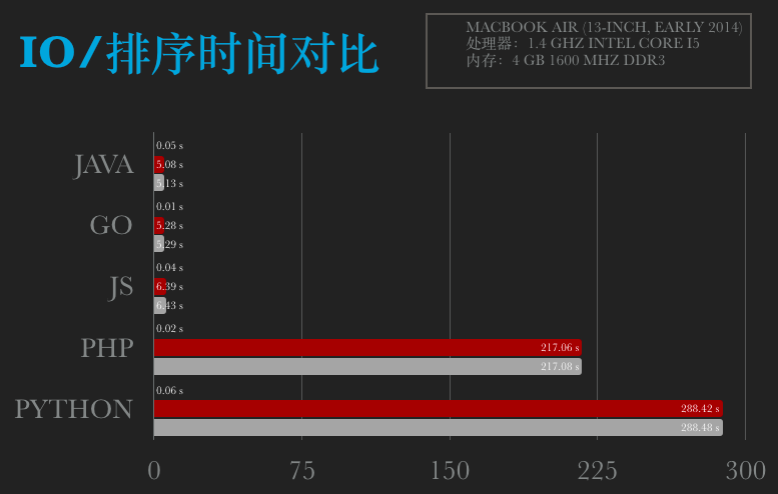
目前这几种编程语言看来,排序如下:IO时长,排序时长,总时长

  1. Java 平均 0.0490s 5.078s 5.127s
  2. Go 平均 0.0058s 5.281s 5.286s
  3. NodeJs 平均 0.0424s 6.389s 6.432s
  4. PHP 平均 0.0200s 217.059s 217.079s
  5. Python 平均 0.0600s 288.422s 288.484s

Ps: 如果你希望看到自己喜欢的语言也排进来,欢迎提供代码!

阅读剩下更多

不同语言下文件读取和排序测试
编程语言

不同语言对网络IO的效率对比

网络IO时间对比图

测试机器配置:

  • MacBook Air (13-inch, Early 2014)
  • 处理器:1.4 GHz Intel Core i5
  • 内存:4 GB 1600 MHz DDR3

PHP

1
2
3
PHP 7.1.16 (cli) (built: Mar 31 2018 02:59:59) ( NTS )
Copyright (c) 1997-2018 The PHP Group
Zend Engine v3.1.0, Copyright (c) 1998-2018 Zend Technologies
1
2
3
4
5
6
7
8
9
10
11
12
13
14
<?php
$t1 = microtime(true);

for($i=0; $i<20; $i++){
$url = "http://2018.ip138.com/ic.asp?count=".$i;
$data = file_get_contents($url);
// echo 'get:'.$i." ".$data."\r\n";
}

$t2 = microtime(true);

echo 'php time:' . ($t2 - $t1)*1000 . "ms\n";

?>

测试结果:

1
2
3
4
5
6
7
8
9
10
11
12
13
14
~/Sites/languageDiff/io » php main.php
php time:2112.9629611969ms
-------------------------------------------------------
~/Sites/languageDiff/io » php main.php
php time:1960.746049881ms
-------------------------------------------------------
~/Sites/languageDiff/io » php main.php
php time:2055.7940006256ms
-------------------------------------------------------
~/Sites/languageDiff/io » php main.php
php time:2052.6430606842ms
-------------------------------------------------------
~/Sites/languageDiff/io » php main.php
php time:1990.2958869934ms

Java

1
2
3
java version "10.0.1" 2018-04-17
Java(TM) SE Runtime Environment 18.3 (build 10.0.1+10)
Java HotSpot(TM) 64-Bit Server VM 18.3 (build 10.0.1+10, mixed mode)
1
2
3
4
5
6
7
8
9
10
11
12
13
14
15
public class Main {

public static void main(String[] args) {
long t1 = System.currentTimeMillis();

for(int i=0; i<20; i++){
String s=HttpRequest.sendGet("http://2018.ip138.com/ic.asp", "count="+i);
// System.out.println(""+i+" : "+s);
}

long t2 = System.currentTimeMillis();

System.out.println("java time: " + String.valueOf(t2 - t1) + "ms");
}
}

HttpRequst.java CodeOrigin:https://www.cnblogs.com/guoyinli/p/7192839.html

1
2
3
4
5
6
7
8
9
10
11
12
13
14
15
16
17
18
19
20
21
22
23
24
25
26
27
28
29
30
31
32
33
34
35
36
37
38
39
40
41
42
43
44
45
46
47
48
49
50
51
52
53
54
55
56
57
58
59
60
61
62
63
64
65
66
67
68
69
70
71
72
73
74
75
76
77
78
79
80
81
82
83
84
85
86
87
88
89
90
91
92
93
94
95
96
97
98
99
100
101
102
103
104
105
106
107
108
109
110
111
112
113
114
115
116
117
118
119
120
121
122
123
124

import java.io.BufferedReader;
import java.io.IOException;
import java.io.InputStreamReader;
import java.io.PrintWriter;
import java.net.URL;
import java.net.URLConnection;
import java.util.List;
import java.util.Map;

public class HttpRequest {
/**
* 向指定URL发送GET方法的请求
*
* @param url
* 发送请求的URL
* @param param
* 请求参数,请求参数应该是 name1=value1&name2=value2 的形式。
* @return URL 所代表远程资源的响应结果
*/
public static String sendGet(String url, String param) {
String result = "";
BufferedReader in = null;
try {
String urlNameString = url + "?" + param;
URL realUrl = new URL(urlNameString);
// 打开和URL之间的连接
URLConnection connection = realUrl.openConnection();
// 设置通用的请求属性
connection.setRequestProperty("accept", "*/*");
connection.setRequestProperty("connection", "Keep-Alive");
connection.setRequestProperty("user-agent",
"Mozilla/4.0 (compatible; MSIE 6.0; Windows NT 5.1;SV1)");
// 建立实际的连接
connection.connect();
// 获取所有响应头字段
Map<String, List<String>> map = connection.getHeaderFields();
// 遍历所有的响应头字段
/*for (String key : map.keySet()) {
System.out.println(key + "--->" + map.get(key));
}*/
// 定义 BufferedReader输入流来读取URL的响应
in = new BufferedReader(new InputStreamReader(
connection.getInputStream()));
String line;
while ((line = in.readLine()) != null) {
result += line;
}
} catch (Exception e) {
System.out.println("发送GET请求出现异常!" + e);
e.printStackTrace();
}
// 使用finally块来关闭输入流
finally {
try {
if (in != null) {
in.close();
}
} catch (Exception e2) {
e2.printStackTrace();
}
}
return result;
}

/**
* 向指定 URL 发送POST方法的请求
*
* @param url
* 发送请求的 URL
* @param param
* 请求参数,请求参数应该是 name1=value1&name2=value2 的形式。
* @return 所代表远程资源的响应结果
*/
public static String sendPost(String url, String param) {
PrintWriter out = null;
BufferedReader in = null;
String result = "";
try {
URL realUrl = new URL(url);
// 打开和URL之间的连接
URLConnection conn = realUrl.openConnection();
// 设置通用的请求属性
conn.setRequestProperty("accept", "*/*");
conn.setRequestProperty("connection", "Keep-Alive");
conn.setRequestProperty("user-agent",
"Mozilla/4.0 (compatible; MSIE 6.0; Windows NT 5.1;SV1)");
// 发送POST请求必须设置如下两行
conn.setDoOutput(true);
conn.setDoInput(true);
// 获取URLConnection对象对应的输出流
out = new PrintWriter(conn.getOutputStream());
// 发送请求参数
out.print(param);
// flush输出流的缓冲
out.flush();
// 定义BufferedReader输入流来读取URL的响应
in = new BufferedReader(
new InputStreamReader(conn.getInputStream()));
String line;
while ((line = in.readLine()) != null) {
result += line;
}
} catch (Exception e) {
System.out.println("发送 POST 请求出现异常!"+e);
e.printStackTrace();
}
//使用finally块来关闭输出流、输入流
finally{
try{
if(out!=null){
out.close();
}
if(in!=null){
in.close();
}
}
catch(IOException ex){
ex.printStackTrace();
}
}
return result;
}
}

测试结果:

1
2
3
4
5
6
7
8
9
10
11
12
13
14
~/Sites/languageDiff/io » java Main
java time: 1416ms
-------------------------------------------------------
~/Sites/languageDiff/io » java Main
java time: 1472ms
-------------------------------------------------------
~/Sites/languageDiff/io » java Main
java time: 1328ms
-------------------------------------------------------
~/Sites/languageDiff/io » java Main
java time: 1348ms
-------------------------------------------------------
~/Sites/languageDiff/io » java Main
java time: 1336ms

Go

1
go version go1.10.3 darwin/amd64
1
2
3
4
5
6
7
8
9
10
11
12
13
14
15
16
17
18
19
20
21
22
23
24
25
26
27
28
29
30
31
32
33
34
35
36
37
38
39
40
package main

import (
"fmt"
"io/ioutil"
"net/http"
"strconv"
"sync"
"time"
)

func main() {
wg := sync.WaitGroup{}
start := time.Now()
for k := 0; k < 2; k++ {
wg.Add(1)
go func(k int) {
for i := 0; i < 10; i++ {
HttpGet("http://2018.ip138.com/ic.asp?count=" + strconv.Itoa(i*2+k))
}
wg.Done()
}(k)
}
wg.Wait()
fmt.Printf("cost time: %f\n", time.Now().Sub(start).Seconds())
}

func HttpGet(url string) string {
resp, err := http.Get(url)
if err != nil {
return err.Error()
}
defer resp.Body.Close()
body, err := ioutil.ReadAll(resp.Body)
if err != nil {
return err.Error()
}
return string(body)
}

测试结果:

1
2
3
4
5
6
7
8
9
10
11
12
13
14
~/Workspaces/go » go run main.go
cost time: 0.952737
-------------------------------------------------------
~/Workspaces/go » go run main.go
cost time: 0.983901
-------------------------------------------------------
~/Workspaces/go » go run main.go
cost time: 0.967799
-------------------------------------------------------
~/Workspaces/go » go run main.go
cost time: 0.972302
-------------------------------------------------------
~/Workspaces/go » go run main.go
cost time: 0.980509

JavaScript(NodeJS)

1
2
~/Sites » node -v
v9.11.1
1
2
3
4
5
6
7
8
9
10
11
12
13
14
15
16
17
18
19
20
21
22
23
24
25
26
27
28
29
30
var t1 = (new Date()).getTime();  
var job = 0;
for(var i=0; i<20; i++){
get(i);
}

var t2 = (new Date()).getTime();

console.log("nodejs time:" + (t2 - t1) + "ms");


function get(i){

var http=require('http');
//get 请求外网
http.get('http://2018.ip138.com/ic.asp?count='+i,function(req,res){
var html='';
req.on('data',function(data){
html+=data;
});
req.on('end',function(){
job++
// console.info(html);
if(job == 20){
var t2 = (new Date()).getTime();
console.log("finished time:" + (t2 - t1) + "ms");
}
});
});
}

测试结果:

1
2
3
4
5
6
7
8
9
10
11
12
13
14
15
16
17
18
19
~/Sites/languageDiff/io » node main.js
nodejs time:25ms
finished time:236ms
-------------------------------------------------------
~/Sites/languageDiff/io » node main.js
nodejs time:21ms
finished time:220ms
-------------------------------------------------------
~/Sites/languageDiff/io » node main.js
nodejs time:22ms
finished time:230ms
-------------------------------------------------------
~/Sites/languageDiff/io » node main.js
nodejs time:21ms
finished time:227ms
-------------------------------------------------------
~/Sites/languageDiff/io » node main.js
nodejs time:20ms
finished time:221ms

Python

1
2
~/Sites » python -V
Python 2.7.10
1
2
3
4
5
6
7
8
9
10
11
12
13
14
15
16
17
18
19
import time,urllib2

def get(url):
req = urllib2.Request(url)

res_data = urllib2.urlopen(req)
res = res_data.read()
return res


t = time.time()

for i in xrange(0, 20):
# print "Get("+str(i)+"):"
data = get("http://2018.ip138.com/ic.asp?count="+str(i))
# print data

print 'Python time: %.02fs' % (time.time() - t)

测试结果:

1
2
3
4
5
6
7
8
9
10
11
12
13
14
15
16
17
~/Sites/languageDiff/io » python main.py
Python time: 1.98s
-------------------------------------------------------
~/Sites/languageDiff/io » python main.py
Python time: 1.98s
-------------------------------------------------------
~/Sites/languageDiff/io » python main.py
Python time: 2.01s
-------------------------------------------------------
~/Sites/languageDiff/io » python main.py
Python time: 2.07s
-------------------------------------------------------
~/Sites/languageDiff/io » python main.py
Python time: 2.20s
-------------------------------------------------------
~/Sites/languageDiff/io » python main.py
Python time: 2.08s

目前这几种编程语言看来,排序如下:

  1. NodeJs 平均 0.23s
  2. Go 平均 0.97s
  3. Java 平均 1.38s
  4. PHP 平均 2.03s
  5. Python 平均 2.05s

Ps: 如果你希望看到自己喜欢的语言也排进来,欢迎提供代码!

阅读剩下更多

不同语言对网络IO的效率对比
编程语言

不同语言的基本性能测试

计算时间对比图
测试机器配置:

  • MacBook Air (13-inch, Early 2014)
  • 处理器:1.4 GHz Intel Core i5
  • 内存:4 GB 1600 MHz DDR3

PHP

1
2
3
PHP 7.1.16 (cli) (built: Mar 31 2018 02:59:59) ( NTS )
Copyright (c) 1997-2018 The PHP Group
Zend Engine v3.1.0, Copyright (c) 1998-2018 Zend Technologies
1
2
3
4
5
6
7
8
9
10
11
12
13
14
15
16
17
18
19
20
21
22
23
24
25
26
27
28
29
30
<?php
$t1 = microtime(true);

for($i=0; $i<10000000; $i++){
aaa($i);
}

$t2 = microtime(true);

echo 'php time:' . ($t2 - $t1)*1000 . "ms\n";

function aaa($i){
$a = $i + 1;
$b = 2.3;
$s = "abcdefkkbghisdfdfdsfds";

if($a > $b){
++$a;
}else{
$b = $b + 1;
}

if($a == $b){
$b = $b + 1;
}

$c = $a * $b + $a / $b - pow($a, 2);
$d = substr($s, 0, strpos($s, 'kkb')) . strval($c);
}
?>

测试结果:

1
2
3
4
5
6
7
8
9
10
11
12
13
14
15
16
17
~/Sites » php tes.php
php time:8196.1958408356ms
-------------------------------------------------------
~/Sites » php tes.php
php time:7649.4419574738ms
-------------------------------------------------------
~/Sites » php tes.php
php time:7908.7510108948ms
-------------------------------------------------------
~/Sites » php tes.php
php time:7708.6410522461ms
-------------------------------------------------------
~/Sites » php tes.php
php time:7515.1500701904ms
-------------------------------------------------------
~/Sites » php tes.php
php time:7468.3780670166ms

Java

1
2
3
java version "10.0.1" 2018-04-17
Java(TM) SE Runtime Environment 18.3 (build 10.0.1+10)
Java HotSpot(TM) 64-Bit Server VM 18.3 (build 10.0.1+10, mixed mode)
1
2
3
4
5
6
7
8
9
10
11
12
13
14
15
16
17
18
19
20
21
22
23
24
25
26
27
28
29
30
31
32
33
public class Main {

public static void main(String[] args) {
long t1 = System.currentTimeMillis();

for(int i=0; i<10000000; i++){
aaa((float)i);
}

long t2 = System.currentTimeMillis();

System.out.println("java time: " + String.valueOf(t2 - t1) + "ms");
}

static void aaa(float i) {
float a = i + 1;
float b = 2.3f;
String s = "abcdefkkbghisdfdfdsfds";

if(a > b){
++a;
}else{
b = b + 1;
}

if(a == b){
b = b + 1;
}

float c = (float)(a * b + a / b - Math.pow(a, 2));
String d = s.substring(0, s.indexOf("kkb")) + String.valueOf(c);
}
}

测试结果:

1
2
3
4
5
6
7
8
9
10
11
12
13
14
15
16
17
18
19
20
~/Sites » java Main
java time: 1537ms
-------------------------------------------------------
~/Sites » java Main
java time: 1497ms
-------------------------------------------------------
~/Sites » java Main
java time: 1466ms
-------------------------------------------------------
~/Sites » java Main
java time: 1610ms
-------------------------------------------------------
~/Sites » java Main
java time: 1488ms
-------------------------------------------------------
~/Sites » java Main
java time: 1503ms
-------------------------------------------------------
~/Sites » java Main
java time: 1475ms

Go

1
go version go1.10.3 darwin/amd64
1
2
3
4
5
6
7
8
9
10
11
12
13
14
15
16
17
18
19
20
21
22
23
24
25
26
27
28
29
30
31
32
33
34
35
36
37
38
package main

import (
"fmt"
"math"
"strconv"
"strings"
"time"
)

func main() {
t1 := time.Now()
for i := 0; i < 10000000; i++ {
Aaa(float64(i))
}
t2 := time.Now()
fmt.Printf("Go time: %f s\n", t2.Sub(t1).Seconds())
}

func Aaa(i float64) {
var a float64 = i + 1
var b float64 = 2.3
s := "abcdefkkbghisdfdfdsfds"

if a > b {
a++
} else {
b = b + 1
}

if a == b {
b = b + 1
}

c := a*b + a/b - math.Pow(a, 2)
d := s[0:strings.Index(s, "kkb")] + strconv.FormatFloat(c, 'E', -1, 64)
_ = d
}

测试结果:

1
2
3
4
5
6
7
8
9
10
11
12
13
14
15
16
~/Workspaces/GoLand/src/Aaa » go build main.go
-------------------------------------------------------
~/Workspaces/GoLand/src/Aaa » ./main
Go time: 4.083166 s
-------------------------------------------------------
~/Workspaces/GoLand/src/Aaa » ./main
Go time: 4.095651 s
-------------------------------------------------------
~/Workspaces/GoLand/src/Aaa » ./main
Go time: 4.154200 s
-------------------------------------------------------
~/Workspaces/GoLand/src/Aaa » ./main
Go time: 4.175203 s
-------------------------------------------------------
~/Workspaces/GoLand/src/Aaa » ./main
Go time: 4.111375 s

Go并发版本

1
2
3
4
5
6
7
8
9
10
11
12
13
14
15
16
17
18
19
20
21
22
23
24
25
26
27
28
29
30
31
32
33
34
35
36
37
38
39
40
41
42
43
44
45
46
package main

import (
"fmt"
"math"
"strconv"
"strings"
"sync"
"time"
)

func main() {
wg := sync.WaitGroup{}
t1 := time.Now()
for k := 0; k < 2; k++ {
wg.Add(1)
go func() {
for i := 0; i < 5000000; i++ {
Aaa(float64(i))
}
wg.Done()
}()
}
wg.Wait()
t2 := time.Now()
fmt.Printf("Go time: %f s\n", t2.Sub(t1).Seconds())
}

func Aaa(i float64) {
var a float64 = i + 1
var b float64 = 2.3
s := "abcdefkkbghisdfdfdsfds"

if a > b {
a++
} else {
b = b + 1
}

if a == b {
b = b + 1
}

c := a*b + a/b - math.Pow(a, 2)
_ = s[0:strings.Index(s, "kkb")] + strconv.FormatFloat(c, 'E', -1, 64)
}

测试结果:

1
2
3
4
5
6
7
8
9
10
11
12
13
14
15
16
~/Workspaces/GoLand/src/Aaa » go build main.go
-------------------------------------------------------
~/Workspaces/GoLand/src/Aaa » ./main
Go time: 2.326077 s
-------------------------------------------------------
~/Workspaces/GoLand/src/Aaa » ./main
Go time: 2.270769 s
-------------------------------------------------------
~/Workspaces/GoLand/src/Aaa » ./main
Go time: 2.277345 s
-------------------------------------------------------
~/Workspaces/GoLand/src/Aaa » ./main
Go time: 2.252540 s
-------------------------------------------------------
~/Workspaces/GoLand/src/Aaa » ./main
Go time: 2.255374 s

JavaScript(NodeJS)

1
2
~/Sites » node -v
v9.11.1
1
2
3
4
5
6
7
8
9
10
11
12
13
14
15
16
17
18
19
20
21
22
23
24
25
26
27
28
29
30
var t1 = (new Date()).getTime();  

for(var i=0; i<10000000; i++){
aaa(i);
}

var t2 = (new Date()).getTime();

console.log("nodejs time:" + (t2 - t1) + "ms");


function aaa(i){
var a = i + 1;
var b = 2.3;
var s = "abcdefkkbghisdfdfdsfds";

if(a > b){
++a;
}else{
b = b + 1;
}

if(a == b){
b = b + 1;
}

var c = a * b + a / b - Math.pow(a, 2);

var d = s.substring(0, s.indexOf("kkb")) + c.toString();
}

测试结果:

1
2
3
4
5
6
7
8
9
10
11
12
13
14
15
16
17
~/Sites » node main.js
nodejs time:4898ms
-------------------------------------------------------
~/Sites » node main.js
nodejs time:5567ms
-------------------------------------------------------
~/Sites » node main.js
nodejs time:4846ms
-------------------------------------------------------
~/Sites » node main.js
nodejs time:4853ms
-------------------------------------------------------
~/Sites » node main.js
nodejs time:4955ms
-------------------------------------------------------
~/Sites » node main.js
nodejs time:5113ms

Python

1
2
~/Sites » python -V
Python 2.7.10
1
2
3
4
5
6
7
8
9
10
11
12
13
14
15
16
17
18
19
20
21
22
23
24
25
26
import sys, time, math

def aaa(i):
a = i + 1
b = 2.3
s = "abcdefkkbghisdfdfdsfds"

if a > b:
a = a + 1
else:
b = b + 1

if a == b:
b = b + 1

c = a * b +a / b - math.pow(a, 2)

d = s[0: s.find("kkb")] + str(c)


t = time.time()

for i in xrange(0, 10000000):
aaa(i)

print 'Python time: %.02f s' % (time.time() - t)

测试结果:

1
2
3
4
5
6
7
8
9
10
11
12
13
14
~/Sites » python main.py
Python time: 20.34
-------------------------------------------------------
~/Sites » python main.py
Python time: 19.90
-------------------------------------------------------
~/Sites » python main.py
Python time: 20.07
-------------------------------------------------------
~/Sites » python main.py
Python time: 19.88
-------------------------------------------------------
~/Sites » python main.py
Python time: 22.89

目前这几种编程语言看来,排序如下:

  1. Java 平均 1.51s (稳居第一)
  2. Go 平均 3.94s (并发2.28s)
  3. NodeJs 平均 5.03s
  4. PHP 平均 7.65s
  5. Python 平均 20.62s (差距大应该是我对这语言不熟,密集运算应该有优化方案)

Ps: 如果你希望看到自己喜欢的语言也排进来,欢迎提供代码!

阅读剩下更多

不同语言的基本性能测试
编程语言

Go语言中的切片(Slice)是引用类型还是值类型?

在最近的学习和实践中,照着别人的代码敲,仅仅只是把别人写在方法内的片段直接拿出来用,结果却出人意料,所以很纳闷!

示例代码:

1
2
3
4
5
6
7
8
func CryptBlocks(dst, src []byte) {
// ...省略内容
for len(src) > 0 {
encrypt(dst, src[:16]) //类似copy
dst = dst[16:]
src = src[16:]
}
}

这个分块处理切片数据的方法很巧妙,我第一次看见的时候(认定切片是传引用),认为这个方法错了,最终dst变成了空切片。

先看一个Slice的例子:

1
2
3
4
5
6
7
8
9
10
11
12
13
14
15
16
17
18
19
package main

import(
"fmt"
)

func main () {
var slice []int
slice = make([]int, 6)
slice = []int{0,1,2,3,4,5}
fmt.Println("Slice: ",slice)
changeSlice(slice)
fmt.Println("Changed Slice: ", slice)

}

func changeSlice(s []int) {
s[2] = 100
}

输出:

1
2
Slice:  [0 1 2 3 4 5]
Changed Slice: [0 1 100 3 4 5]

我们会发现,在方法changeSlice中对形参的修改即真实修改。如果这时我们将其定性为引用传值,为之过早!

我们将代码稍微修改一下:

1
2
3
4
5
6
7
8
9
10
11
12
13
14
15
16
17
18
19
20
package main

import(
"fmt"
)

func main () {
var slice []int
slice = make([]int, 6)
slice = []int{0,1,2,3,4,5}
fmt.Printf("SliceAddr: %p , Slice: %v\r\n",&slice, slice)
changeSlice(slice)
fmt.Printf("Changed SliceAddr: %p , Changed Slice: %v\r\n", &slice, slice)

}

func changeSlice(s []int) {
fmt.Printf("In func's sliceAddr: %p\r\n", s)
s[2] = 100
}

输出:

1
2
3
SliceAddr: 0xc82000e0a0 , Slice: [0 1 2 3 4 5]
In func's sliceAddr: 0xc8200460c0
Changed SliceAddr: 0xc82000e0a0 , Changed Slice: [0 1 100 3 4 5]

由此可见,在方法内的那个s(地址:0xc8200460c0)并非传入的那个slice(地址:0xc82000e0a0),但是为什么它的修改能影响到原来的数据呢?

阅读剩下更多

默认配图
返回顶部